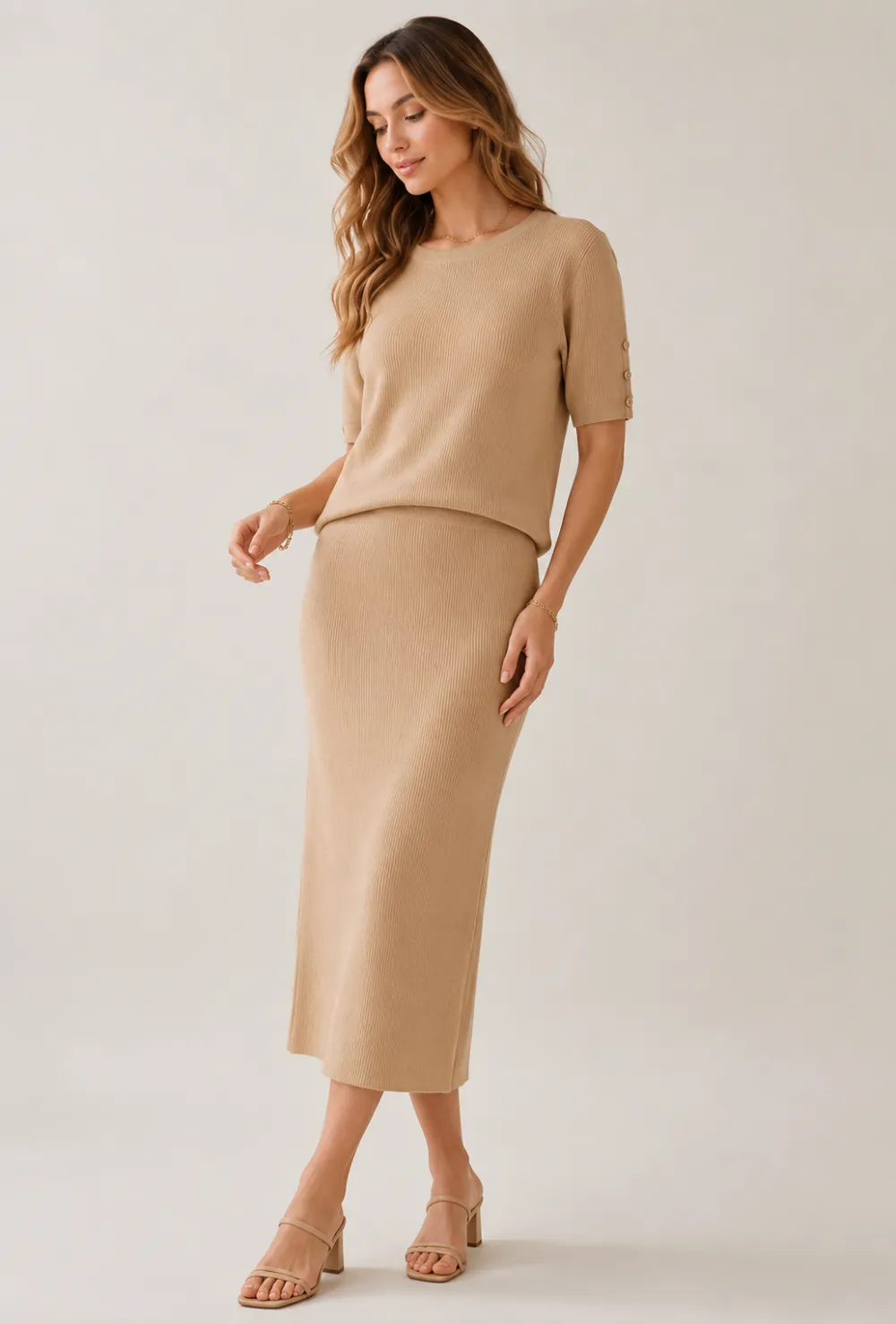
Knit sets are one of the fastest-growing categories in the knitwear market.
From viral "grandmillennial" sets on TikTok to high-end brand knit two-piece ready-to-wear lines, to spring/summer cami+cardigan combinations — consumers are increasingly embracing the "buy as a set, wear as a set" concept. For brands, promoting sets beats promoting single items — higher average order value (typically $25–60/set, 2–3 times the $12–25 for a single top), higher repeat purchase rates, and stronger social media shareability.
But sourcing sets is several times more complex than sourcing single items. The top and bottom must match in color, shrinkage, and design language — if any one link in production goes wrong, the entire batch could be scrapped.
This article covers set categorization, technical challenges, yarn matching, and factory selection criteria to help brands build a complete understanding of knit set sourcing.
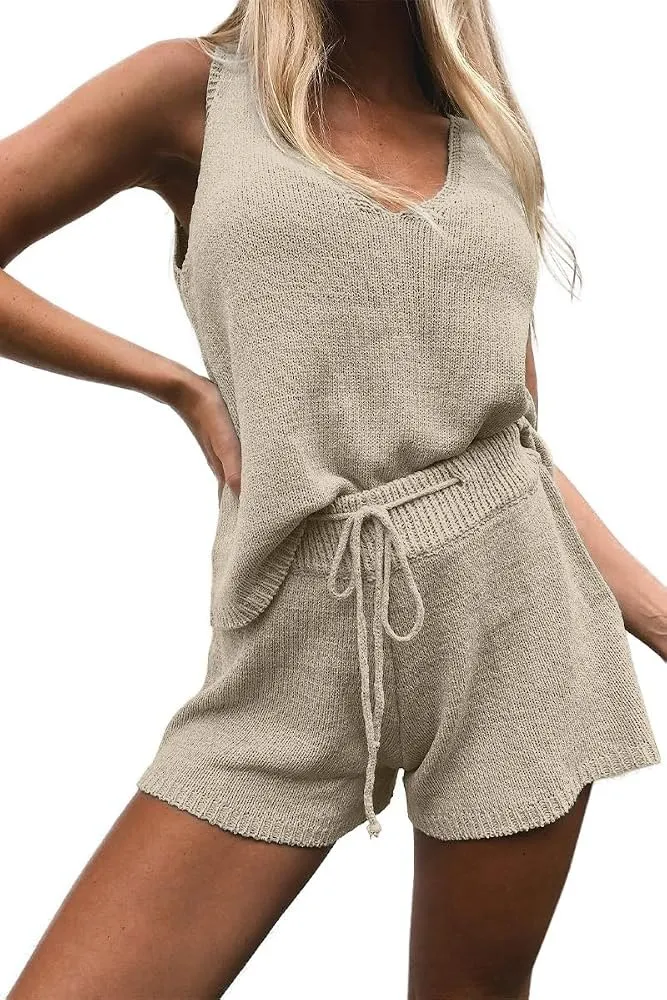
1. Knit Set Category Overview
A knit set is not a "new single item" but a combination of two (or more) knit pieces. However, the sourcing logic is completely different from single items.
1.1 Classification by Combination Type
| Set Type | Composition | Typical Gauge | Main Season | Market Heat |
|---|---|---|---|---|
| Top + shorts/skirt | Short/long sleeve top + shorts/skirt | 9G–14G | Spring/Summer | 🔥🔥🔥🔥 |
| Cardigan + cami/vest | Cardigan outer + inner vest | 12G–16G | Spring/Summer, layering | 🔥🔥🔥🔥🔥 |
| Top + pants/long skirt | Long sleeve top + straight/wide leg pants/long skirt | 7G–12G | Fall/Winter | 🔥🔥🔥 |
| Sweater + scarf/hat | Sweater + accessories | 5G–14G | Fall/Winter | 🔥🔥 |
| Three-piece (top + bottom + outer) | Inner + outer + bottom | 7G–14G | Fall/Winter | 🔥🔥 |
| Mother-daughter/matching sets | Same design in two sizes | 7G–14G | All seasons | 🔥🔥🔥 |
1.2 Why Brands Should Offer Sets
- Double the AOV: A set typically sells at 2–3 times the price of a single top
- Bundled sales: Promoting one set pushes two or more items at once
- Reduced SKU decision burden: Consumers don't need to think about coordinating — they grab the set
- Stronger social sharing: The "complete look" of a set photographs better on Xiaohongshu/Instagram/TikTok
For market trends in knitwear categories, check out our knitwear industry news section.
2. Four Major Technical Challenges in Knit Set Sourcing
"Making two identical sweaters" sounds simple, but matching multiple knit pieces in practice is very tricky.
2.1 Color Consistency — Same Dye Lot ≠ Same Color
Many assume that using the same yarn batch for top and bottom eliminates color difference. However:
- Knitting density differences: Top and bottom may have different densities (e.g., 12G jersey for the top, 12G rib for the bottom), causing different yarn light reflection — they can look like different colors
- Finishing process effects: After fulling, washing, and softening, components with different weights react differently to the process, causing visible color differences
Solutions:
- Process the top and bottom together through finishing (same batch, same drum)
- Clearly mark dye lot numbers; use the exact same dye lot for the entire order
- During PP sample approval, lay both pieces side by side to check color consistency
2.2 Shrinkage Rate Matching
This is the most hidden "time bomb" in set production.
Due to different knit structures (jersey vs rib vs jacquard), the top and bottom naturally have different shrinkage rates. After several washes, the top may fit perfectly while the bottom shrinks into tights — or vice versa.
Solutions:
- Perform 3-cycle shrinkage tests on the set after sampling — wash top and bottom together
- Shrinkage rate difference must be kept within 1.5%
- For set plans with shrinkage differences > 2%, adjust knitting density or finishing processes
2.3 Fit Coordination
A set is not two independent pieces but a visual whole.
- Ease relationship: If the top is loose-fitting, the bottom should not be too loose or the whole outfit looks bulky; a fitted top can pair with a slightly wider bottom
- Shoulder-to-hip balance: The top's shoulder width and the bottom's hip/waist circumference should have a design relationship
- Style unity: If the top is vintage jacquard, the bottom should not be minimalist jersey
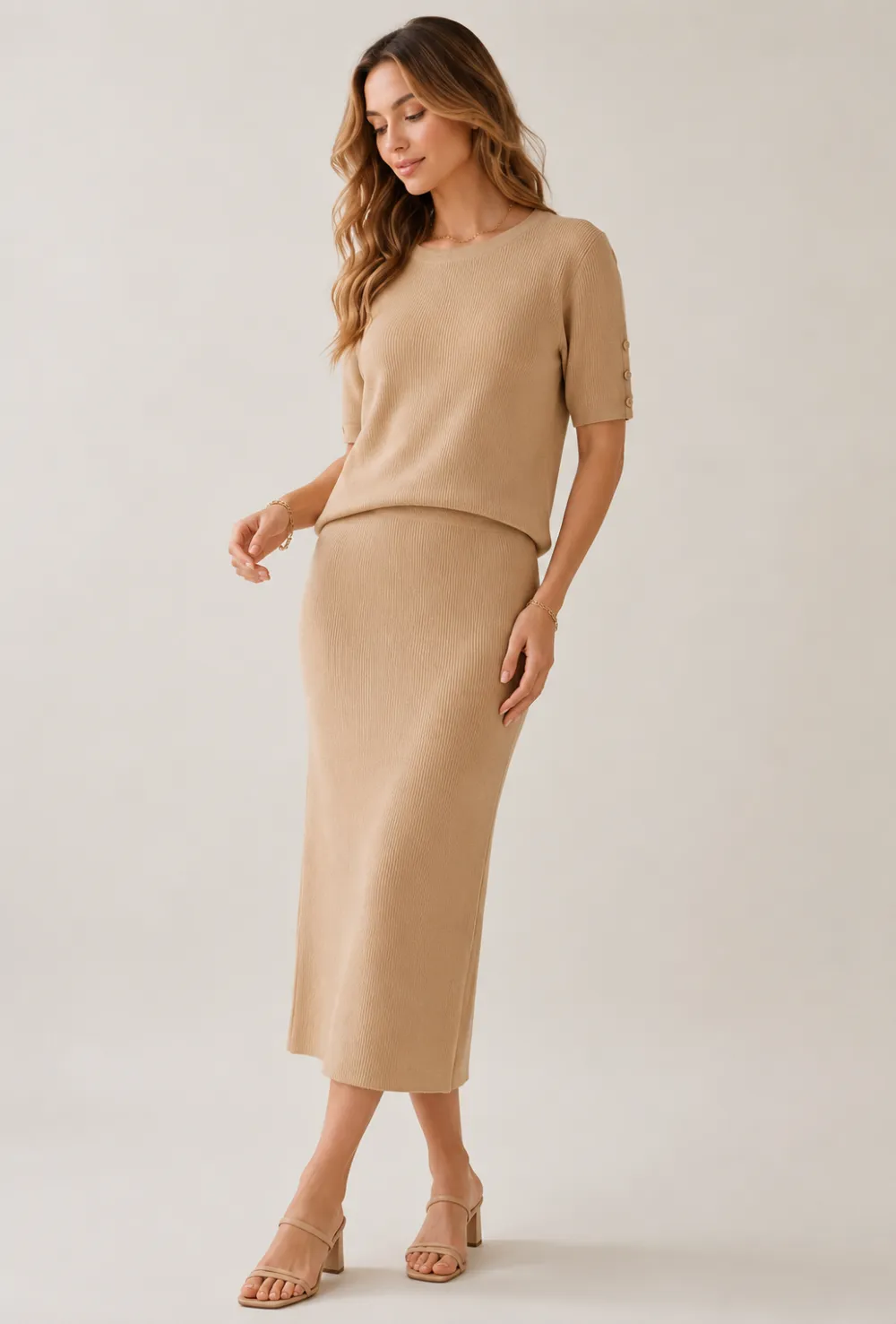
2.4 Seam and Assembly Craftsmanship
Since sets involve two or more pieces, seam consistency and neatness require more attention than single items:
- Seam thread color consistency: Both pieces must use the same batch of thread and color — otherwise, the thread color may differ after washing and wearing
- Consistent seam methods: Side seams, shoulder seams, and hems should be finished the same way on both pieces (e.g., both using 4-thread overlock or both using hand stitching)
- Label placement consistency: Ensure care labels and neck labels are aligned on both pieces for a premium feel
3. Gauge and Yarn Recommendations for Different Sets
| Set Type | Recommended Gauge | Recommended Yarn | Key Notes |
|---|---|---|---|
| Spring/summer shorts/skirt set | 12G–14G | Mercerized cotton, cotton/linen, viscose blend | Light and breathable; keep top and bottom density as close as possible |
| Cardigan + cami set | 12G–16G | Worsted wool, cashmere blend, Tencel | Cardigan in mid-gauge, cami in fine gauge (control density difference) |
| Fall/winter pants/long skirt set | 7G–12G | Wool, wool/acrylic blend, cashmere | Shrinkage rate testing is mandatory for both pieces |
| Children's/matching sets | 9G–14G | Cotton, cotton/wool blend | Stricter safety standards, eco-friendly dyeing |
| Vacation/casual sets | 9G–12G | Cotton, viscose, linen blend | Focus on color coordination and silhouette design |
For yarn material selection, refer to our Yarn Cost Comparison Guide: Wool, Cashmere & Blends and Acrylic-Cotton Blend Material Guide.
4. Set Fit Design Essentials
4.1 Top Fit
- Cropped top: 40–50cm body length is the most popular proportion (reveals the waistline); use a wide ribbed hem for a snug finish
- Regular-length top: 55–65cm body length; the hem should match the bottom's waistband height — mid-rise bottoms should pair with tops that aren't too short
- Cardigan outer: Length should be 3–5cm longer than the inner layer for layering effect
4.2 Bottom Fit
- Knit shorts: Hip ease should be 5%–10% less than woven shorts (knit fabric has built-in stretch)
- Knit skirt (for sets): Should have an elastic waistband to prevent slipping when worn with the top
- Knit pants: The least recommended (and most difficult) — knit pants tend to bag at the knees and seat, requiring dense knitting or lining
For fit points on men's and children's categories, refer to Men's Knitwear Sourcing Guide and Kids' Sweater Sourcing Guide.
4.3 Color Coordination Strategies
- Tonal sets: The safest and best-selling — same color for both pieces, but create visual variation through different knit structures (rib + jersey)
- Contrast sets: More demanding — the two colors must have a clear design logic in hue, saturation, and brightness
- Black & White classics: White + black sets consistently rank among top sellers, but also require the strictest color control
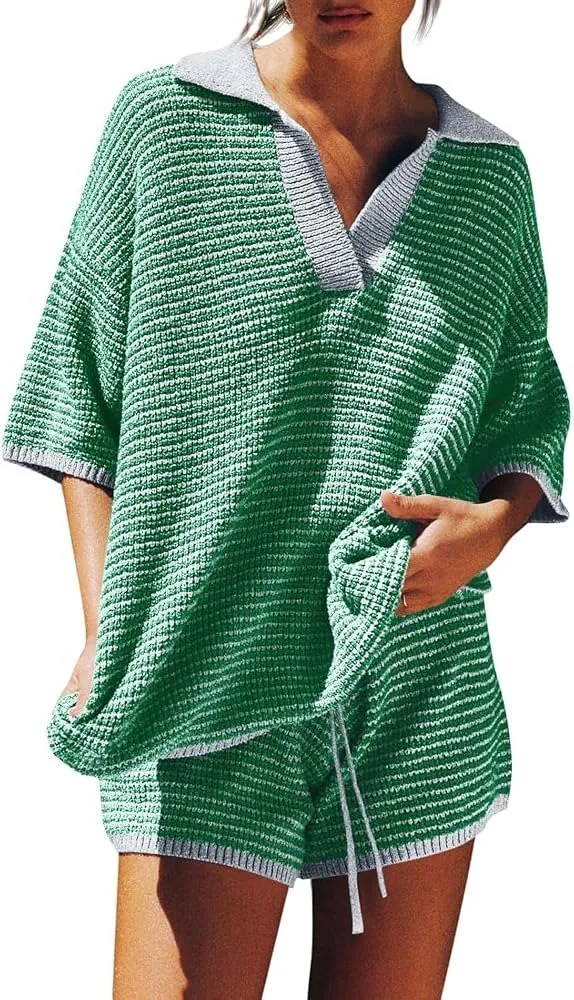
5. Key Questions When Choosing a Knit Set Manufacturer
1. How do you ensure color consistency between top and bottom in a set?
A good factory will explain their specific measures — same yarn batch, same dye lot, both pieces processed together through finishing. Factories with documented color control SOPs are trustworthy partners.
2. Do you test shrinkage for the set pieces separately or together?
The correct answer is: separately AND together. Separate tests reveal each piece's shrinkage; combined tests show how they match after washing and wearing. Factories that only test separately lack expertise.
3. If both pieces use the same yarn but different knit structures, how do you handle visual color difference from density variation?
Professional factories adjust knitting density and finishing parameters to minimize visual differences between structures. If a factory says "it's the same yarn batch so there can't be color difference," it shows a lack of set experience. For quality inspection references, see Complete Guide to Knitwear Quality Inspection Standards.
4. How do you handle sizing for sets?
Set top and bottom don't simply use the same size ratio. For example, a size S top pairs with size S shorts. But consumers with different body types may need different sizes for top and bottom — whether the factory offers flexible sizing (e.g., XS/S/M/L with cross-size wear) indicates their maturity in the set category.
5. How is set sampling charged? Is there a separate fee?
Set sampling = cost of making two samples. A reasonable charge is 1.5–2 times the single-item sampling fee (due to matching processes). If the factory says "free sampling, pay when you order bulk," clarify their return and revision policies.
6. Recommended Knit Set Sourcing Process
- Define set positioning — Determine the style combination (top+shorts, cardigan+cami, etc.), target market, and price range. Communicate clearly with design drawings or reference images
- Prepare complete design documents — Each piece needs its own size spec sheet and tech sheet. The Tech Pack Preparation Guide can help you prepare standardized documents
- Select factory (focus on set experience) — Prioritize factories with actual set delivery cases, not those padding their portfolio with single-item examples
- Sampling (10–14 days) — Set sampling takes 3–5 days longer than single items because it involves matching two pieces
- Wash testing (5–7 days) — Focus on shrinkage consistency between top and bottom; difference should be ≤ 1.5%
- PP sample approval — Lay both pieces side by side to check color difference, fit coordination, and seam consistency
- Bulk production — Recommend in-line inspections (during knitting and sewing stages)
- Packaging for set shipment — Sets are best packaged together (same bag/box); care labels and hang tags should also be designed as a set
Summary: Knit sets are one of the most worthwhile knitwear categories for brands to invest in — higher AOV, strong bundling, good social shareability. But the sourcing difficulty is a level above single items: color consistency, shrinkage matching, fit coordination — if any link fails, the entire set could be wasted.
Choosing a factory with proven set experience is the first step for brands entering the knit set market.
Planning to develop a knit set collection? Feel free to contact us for a free consultation and quotation. Also read our Women's Knitwear Sourcing Guide and Cardigan Procurement Guide for more knitwear category insights.