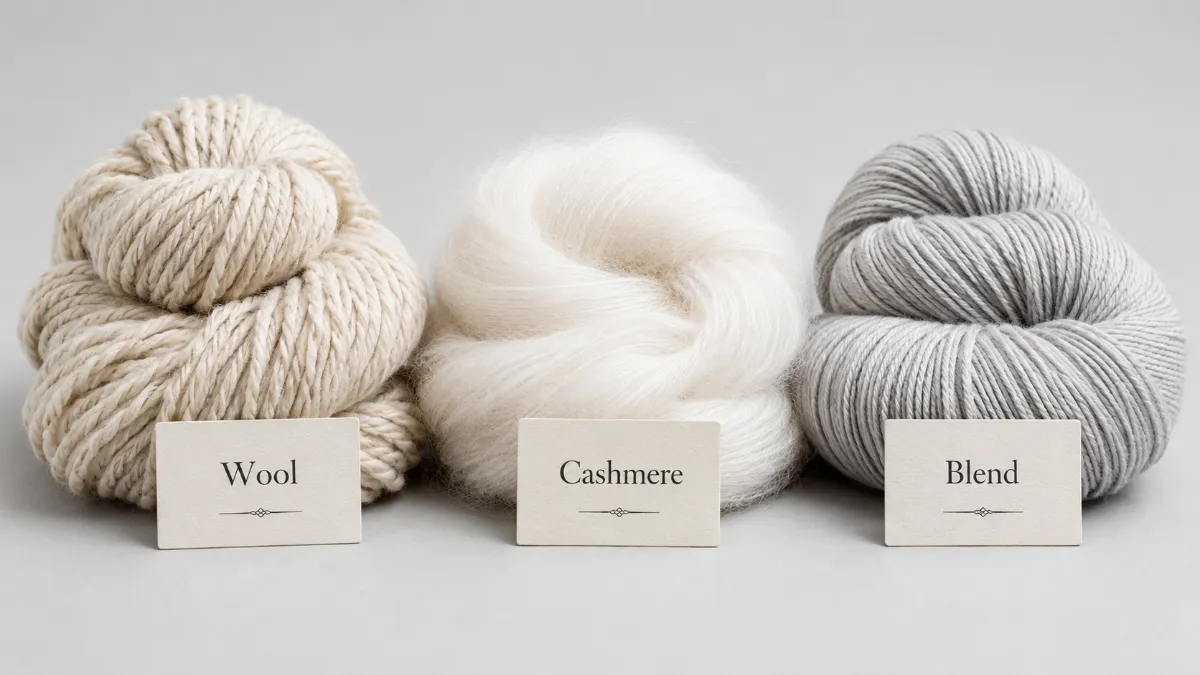
The same sweater style in pure wool, cashmere, or a blend can have raw material costs differing by 3-8x. When developing knitwear products, choosing the right material directly impacts your pricing space and market positioning.
This article breaks down raw material characteristics, realistic costs, and best-use scenarios across three dimensions to help you make the optimal material choice.
The Basics of the Three Materials
| Material | Fiber Source | Raw Material Price (RMB/kg) | Annual Production | Core Selling Point |
|---|---|---|---|---|
| Pure Wool | Sheep | 80-200 | Abundant | Good warmth, excellent elasticity, great value |
| Cashmere | Goat (undercoat) | 600-1,200 | Scarce (approx. 20,000-30,000 tons/year globally) | Extremely light, extremely soft, extremely warm |
| Wool Blend | Wool + synthetic fiber/cotton | 60-150 | Most widely available | Cost-controllable, customizable functionality |
Reference data: Global cashmere annual production is approximately 25,000-30,000 tons, of which China accounts for over 70% (Inner Mongolia is the main producing region). Wool annual production is approximately 2 million tons — cashmere's scarcity determines its price.
1. Pure Wool: The Classic, Reliable Sweater Material
Common Wool Types
| Type | Fineness (μm) | Hand Feel | Price | Main Origin |
|---|---|---|---|---|
| Merino Wool | 15-19 | Very soft, can be worn next to skin | High | Australia |
| Lambswool | 18-22 | Soft, first shearing | Medium-high | Australia, New Zealand |
| Standard Wool | 24-30 | Slightly itchy feel | Medium | China, New Zealand, South America |
| Crossbred Wool | 30-36 | Coarser, suitable for outerwear | Low | Various countries |
Advantages
- Natural warmth — Wool fibers have natural crimp, forming an insulating air layer
- Breathable and moisture-wicking — Can absorb up to 30% of its weight in moisture without feeling damp
- Good elasticity — Can stretch 30-50% and return to original shape
- Flame-resistant — Naturally flame-resistant, does not melt
Disadvantages
- May shrink — Untreated (non-Superwash) wool can felt in hot water
- Irritates some skin types — Standard wool fibers are coarse; sensitive skin may feel itchy
- Higher care requirements — Most wool sweaters require hand washing or dry cleaning
Best Uses for Pure Wool
| Category | Recommendation | Recommended Wool Type |
|---|---|---|
| Fall/Winter basic sweaters | Good warmth, reasonable price | Merino or Lambswool |
| Business knitwear | High-quality look, crisp shape | Merino wool |
| Shawls / Scarves | Warm + good hand feel | Lambswool or Merino |
| Mid-to-high-end export styles | Highly recognized in European/US markets | Superwash-treated Merino |
2. Cashmere: The First Choice for Light Luxury Positioning
Cashmere is not wool — it comes from the undercoat of goats. Each goat produces only 100-200 grams of raw cashmere per year. A single pure cashmere sweater requires the fiber from 3-5 goats.
Why Is Cashmere Expensive?
| Factor | Description |
|---|---|
| Extremely low yield | One sheep produces 3-5kg of wool per year; one goat produces only 100-200g of cashmere |
| High collection cost | Hand-combed in spring; cannot be sheared (shearing damages the outer guard hair) |
| High sorting loss | Raw cashmere contains coarse hair and impurities; actual usable yield after dehairing is about 50-60% |
| High processing requirements | Cashmere fibers are short (26-32mm); spinning and knitting require higher precision |
| Brand premium | Consumer perception means "cashmere" carries a built-in luxury label |
Core Advantages of Cashmere
- Extremely light — Under equal warmth conditions, cashmere is about 30-40% lighter than wool
- Extremely soft — Cashmere fiber diameter is only 14-16μm (even fine Merino is 16μm+), finer and smoother
- Extremely warm — Cashmere's hollow structure provides about 1.5-2x the insulation of wool
A 200g pure cashmere sweater provides warmth equivalent to a 350g Merino wool sweater.
Limitations of Cashmere
- High price — Raw material cost is 4-6x that of Merino
- Pills easily — Cashmere fibers are short; pilling occurs with friction (a natural characteristic, not a quality defect)
- More delicate care — Must be dry-cleaned or hand-washed
- Many market fakes — Numerous "baby cashmere" or "lambswool cashmere" (actually wool) products confuse consumers
Best Uses for Cashmere
| Scenario | Description |
|---|---|
| High-end brand Fall/Winter main line | Key styles priced $150-$300+ |
| Boutique/department store channels | Needs a material story to support the premium |
| Custom gifts / corporate bulk orders | Cashmere scarves, cashmere sweaters — a prestigious gift |
| Extreme cold markets (Nordic/Canada) | Light yet warm characteristics especially valued |
3. Wool Blends: Balancing Cost, Function, and Hand Feel
Blending is the most flexible strategy — by adjusting the fiber ratio, you can create yarns that meet different price points and functional requirements.
Common Blend Options
| Blend Type | Typical Ratio | Advantage | Cost Comparison (vs pure wool) |
|---|---|---|---|
| Wool + Acrylic | 50:50 or 30:70 | Low cost, good color, anti-pilling | 30-50% lower |
| Wool + Cotton | 50:50 | Skin-friendly feel, wearable year-round | 20-30% lower |
| Wool + Tencel/Modal | 70:30 | Good drape, slightly cool feel suitable for spring/summer | 10-15% higher |
| Wool + Mulberry Silk | 80:20 | Good luster, ultra-smooth | 30-50% higher |
| Cashmere + Wool | 30:70 or 50:50 | Reduces cost while retaining cashmere hand feel | 20-40% higher (1/3 of pure cashmere) |
Cashmere + wool blend is the most popular mid-to-high-end solution in recent years. Sweaters with 30% cashmere content have a hand feel close to pure cashmere, but cost only 40-50% of pure cashmere. They can be priced in the $80-$120 range, making it the most commonly used high-volume strategy for brands.
4. Three Materials, Three Positioning Strategies
Brand Positioning → Material Choice → Retail Price (FOB cost ratio) Low-end volume → Wool + acrylic blend → $15-$30 (cost ~30-40%) Mid-range quality → Pure Merino wool → $30-$80 (cost ~25-35%) Mid-high specialty → Cashmere + wool blend → $60-$150 (cost ~20-30%) High-end luxury → Pure cashmere → $120-$300+ (cost ~15-25%)Note: These are approximate brand retail price ranges. FOB cost ratios vary based on style complexity, order quantity, and finishing processes.
How to Choose a Processing Factory?
Choosing the material also means choosing the factory — different materials have very different processing requirements.
| Material | Factory Requirements | Key Inspection Points |
|---|---|---|
| Pure Wool | Most knitwear factories can handle it | Do they have Superwash treatment capability? Anti-shrink pass rate? |
| Cashmere | Requires a dedicated cashmere production line | Is the yarn supplier legitimate? Is the dehairing process up to standard? Is the raw material sourcing traceable? |
| Blends | Higher demands on the spinning mill (knitting process is the same) | Is the blend ratio accurate? Is yarn twist stable? Does the yarn supplier provide color fastness reports? |
Suggestion: Determine your material direction first, then select the factory. For cashmere or high-wool-content products, prefer factories with dedicated cashmere/wool production lines (typically in Inner Mongolia, Hebei Qinghe, or specialized knitwear factories in Dalang, Dongguan).
Frequently Asked Questions
Why are some "pure wool sweaters" only a few dollars?
They are typically made from standard coarse wool (fiber diameter 30μm+) or use ultra-fine acrylic冒充 wool. For a genuine 100% Merino wool sweater from a reputable source, the raw material cost alone is RMB 80-150 per piece (depending on weight and gauge). Any so-called "pure wool" sweater with a retail price below RMB 150 requires careful verification of the composition label.
What is the approximate cost of a pure cashmere sweater?
Take a standard women's cashmere sweater (approximately 180-220g): raw material cost is about RMB 100-180 (depending on cashmere quality), processing cost is about RMB 40-70 (including linking, washing, pressing). The total FOB cost is approximately RMB 140-250 per piece. Brand retail prices typically range from RMB 800-2,000.
How do I wash a cashmere sweater without shrinking it?
Cashmere sweaters cannot be machine washed. Proper care: hand wash in cold water (use specialized cashmere detergent) → do not wring → dry flat → store folded. If the factory has applied an anti-shrink treatment (chlorination + resin coating), felting can be reduced, but most cashmere materials still cannot be made fully machine-washable like Superwash wool.
Is "baby cashmere" or "lambswool cashmere" real cashmere?
No. Only "goat cashmere (Cashmere)" is true cashmere by definition. "Baby cashmere" and "lambswool cashmere" are marketing terms — they are actually wool or lambswool. When purchasing, look for "100% cashmere" or "100% goat cashmere" on the composition label. The Chinese national standard GB/T 18132-2016 has strict requirements for cashmere content in cashmere products.
What should I watch out for when ordering custom blends from a factory?
The key is accurate verification of the blend ratio. Some factories operate on a "close enough" basis, and discrepancies between actual yarn composition and labeled composition can lead to quality disputes. Recommendations: ① Request color fastness and composition reports from the factory's yarn supplier; ② Conduct third-party composition testing before bulk production; ③ Stipulate the acceptable blend ratio tolerance (typically ±3%) in the contract.
Want to learn more about matching the right sweater material to your brand positioning and budget? Check out our sweater OEM/ODM customization process, or contact us directly to discuss your product requirements.