Knitwear Techniques & Terminology Knowledge Base
Understanding the value of a knit product — it comes from the combined control of yarn, structure, gauge, pattern room, finishing, and quality control. This process map translates industry terminology into language that brand clients and buyers can understand, covering the common fabric structures, yarn counts, gauge (GG), fully fashioned knitting, and shrinkage concepts for all product categories — reducing communication friction and demonstrating factory expertise.
What is Knitwear
Formed from yarn rather than woven fabric that is cut and sewn — this is the fundamental difference between knitwear and woven garments. Yarn is looped into stitches on a needle bed, interlocking row by row to directly form garment panels or even complete garments.
Elastic & Fitted
Loop structures naturally stretch and recover, offering comfortable movement and a body-friendly fit.
Material Efficient
Panels or whole garment can be knitted to size directly, minimizing waste and maximizing yield.
Rich Pattern Expression
From structure variations, jacquard, intarsia, and cables to eyelets — a wide range of textures and motifs.
Warm & Breathable
Air pockets within the loop structure provide both insulation and breathability, suitable across seasons.
Knitwear products include sweaters, cardigans, dresses, scarves, hats, shawls and more, widely used in everyday wear, business, sportswear, and high-end fashion. Understanding the "forming logic" of knitwear helps clients grasp the subsequent details of techniques, materials, and quality control.
8 Core Processes
The complete chain from style analysis, yarn selection, sampling, knitting, to packing and shipping. Understanding this chain helps pinpoint every node of quality control.
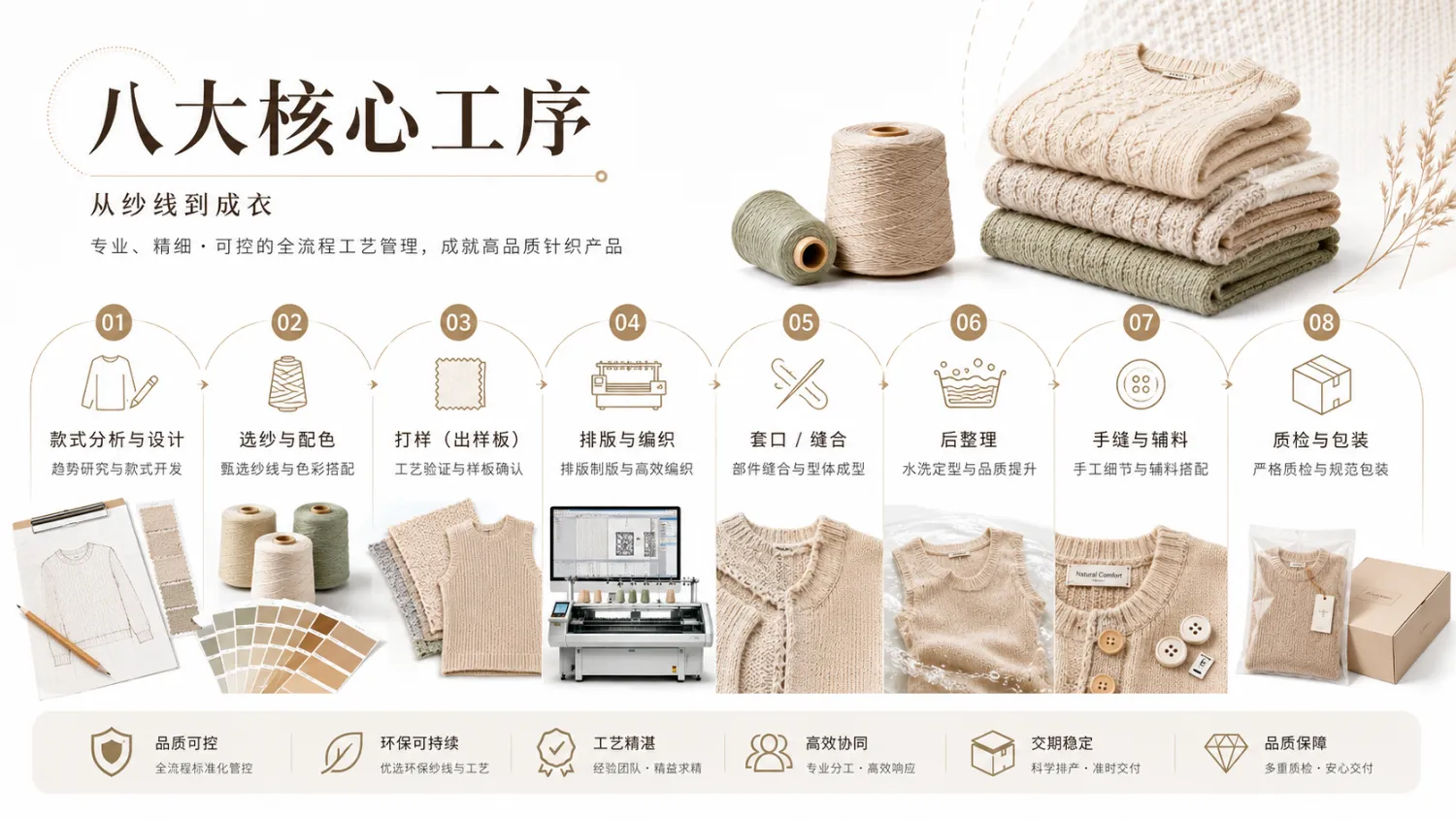
① Style Analysis
Interpret design drawings, measurement spec (度尺), and technical requirements — determine structure, pattern, and fit.
② Yarn & Color Selection
Choose yarn material and count based on hand feel, season, and budget. Finalize color scheme.
③ Sample Development
Knit a sample garment, check measurements, hand feel, shrinkage, and appearance. Revise until confirmed.
④ Pattern & Knitting
Convert the approved sample into a knitting program with stitch counts. Knit all garment panels on the machine.
⑤ Linking & Seaming
Join front, back, and sleeve panels using a linking machine or looping process to form the garment.
⑥ Finishing
Washing, milling, setting, and steaming to stabilize dimensions and achieve the desired hand feel and appearance.
⑦ Handwork & Trims
Button sewing, buttonhole finishing, embroidery, beading, label attachment, and other detail work.
⑧ QC & Packing
Inspect dimensions, appearance, and defects. Final ironing, folding, bagging, and shipping preparation.
Fabric Structures
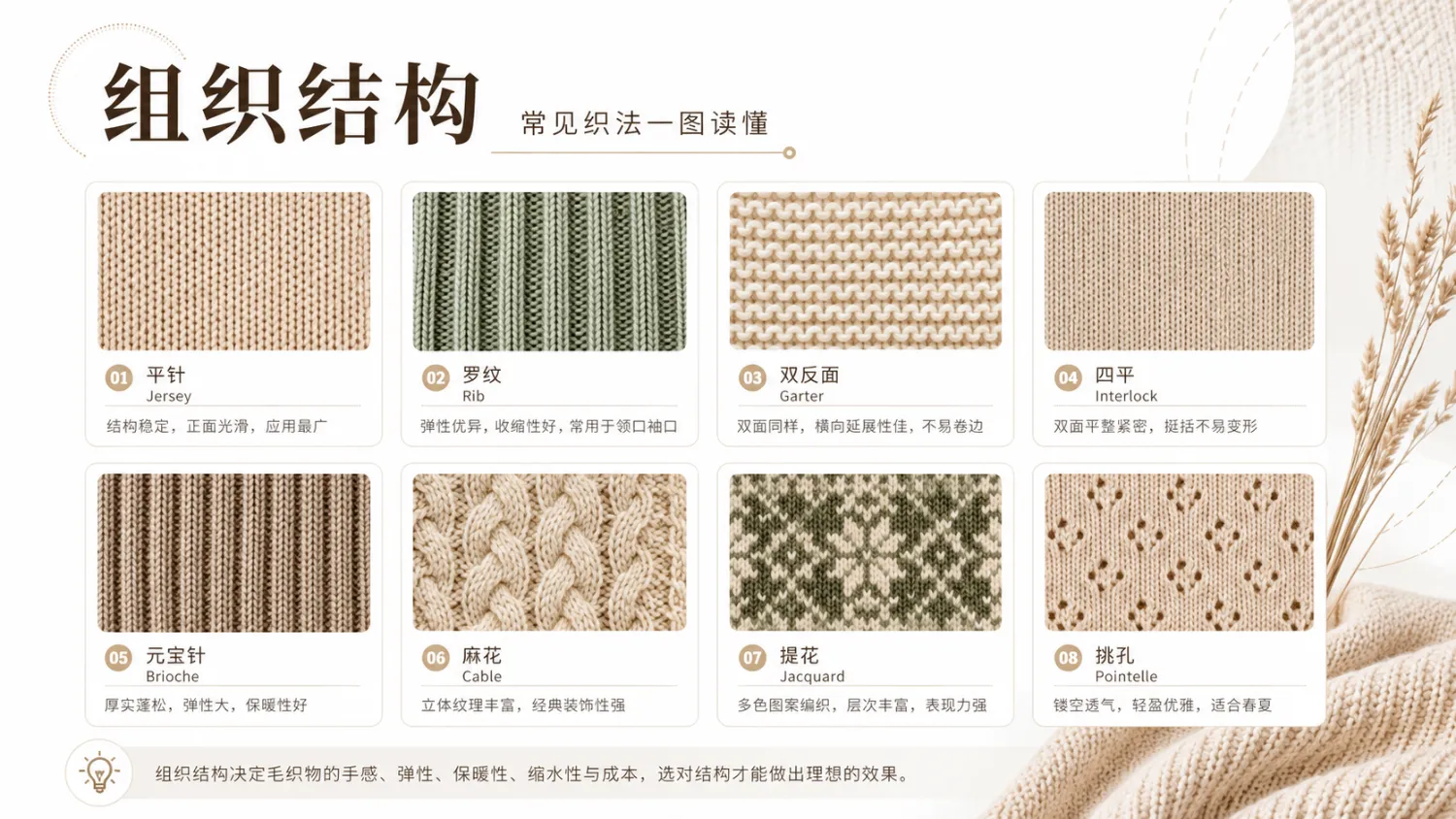
The way stitches interlock determines the appearance, hand feel, elasticity, warmth, shrinkage, and cost of a knitted fabric — the first decision in technique design.
| Structure | Also Known As | Appearance | Common Uses |
|---|---|---|---|
| Jersey / Stockinette | Single Jersey, Weft Knit | Smooth "V" loops on face, horizontal purl on back | Basic styles, inner layers, lightweight sweaters |
| Rib | Ribbed, 1×1, 2×2 | Vertical alternating ridges, high elasticity | Hem, collar, cuffs, fitted styles |
| Garter | Plain Reverse | Horizontal ridges on both sides, good lateral stretch | Scarves, childrenswear, textured styles |
| Interlock | Double Jersey | Smooth double-sided, thick and crisp | Heavyweight sweaters, outerwear |
| Brioche | Fisherman, Half Cardigan | Pronounced raised ribs, airy and warm | Fall/winter heavy knits, classic styles |
| Cable | Twisted Rope | 3D twisted rope texture | Classic Aran-style, heavy knit sweaters |
| Jacquard | Fair Isle | Multi-color patterns, floats on reverse | Patterned sweaters, ethnic style |
| Pointelle / Eyelet | Openwork | Small open holes forming patterns | Spring/summer lightweight, womenswear |
The choice of structure simultaneously affects weight, elasticity, shrinkage, warmth, and cost.
Yarn & Materials
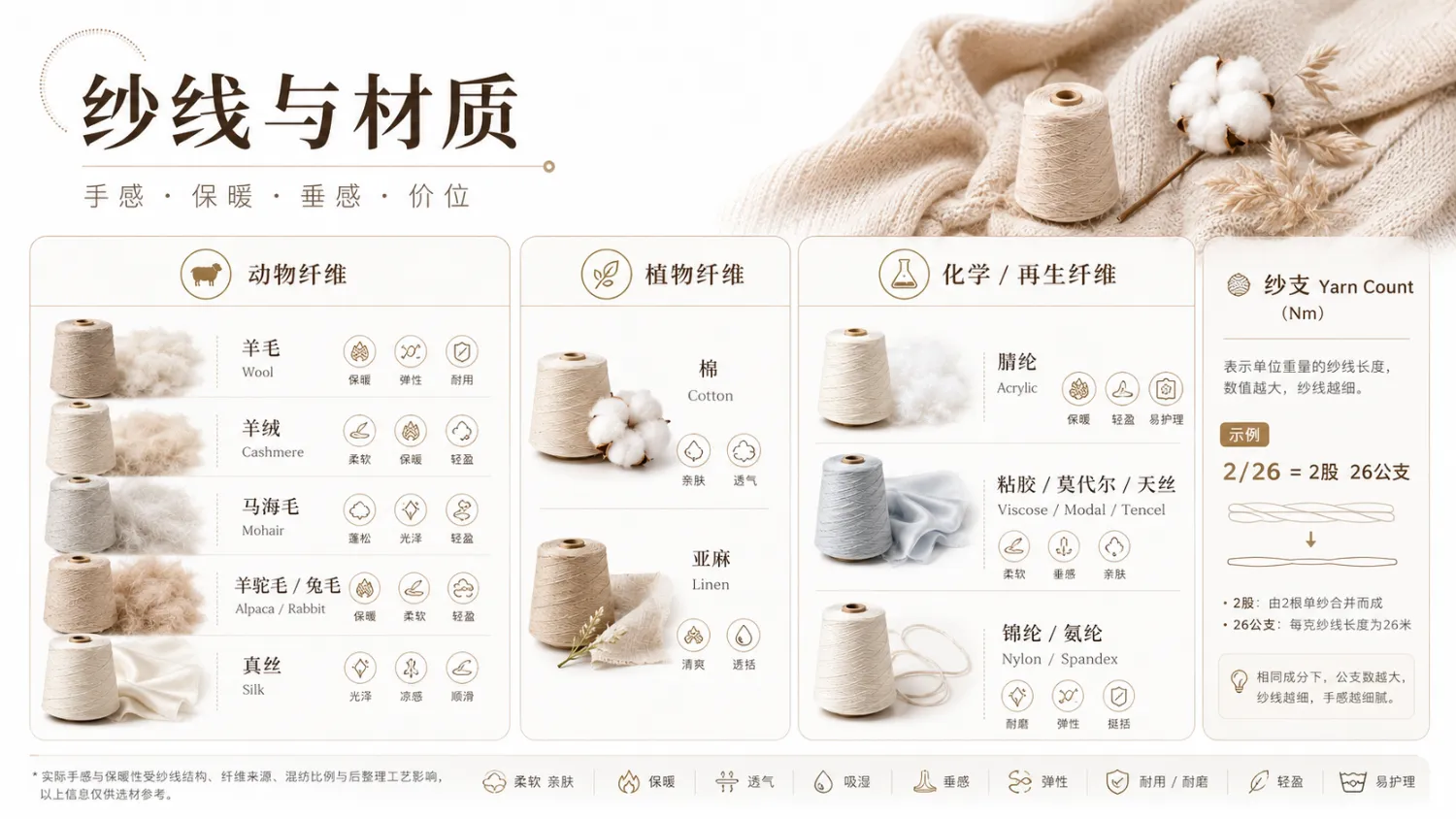
Yarn determines hand feel, drape, warmth, weight, pilling behavior, and price — the most important decision before quoting and sampling. Common materials fall into three categories.
Animal Fibers
Wool, cashmere, mohair, alpaca, rabbit hair, silk. Warm, soft, high value — ideal for mid-to-premium products. Merino fibers are fine and non-itchy; cashmere is known as "soft gold."
Plant Fibers
Cotton, linen. Breathable, moisture-wicking — suitable for spring/summer styles, next-to-skin garments, and natural-look products.
Chemical / Regenerated Fibers
Acrylic, viscose, modal, Tencel, nylon, elastane. Used to enhance cost-effectiveness, drape, elasticity, or abrasion resistance, commonly in blends.
Yarn count is commonly expressed in metric count (Nm). For example, 2/26 means 2-ply yarn at 26 Nm. Typically, for the same material, a higher number means a finer yarn. The yarn count combined with gauge determines the final fabric thickness and density.
Gauge & Machines
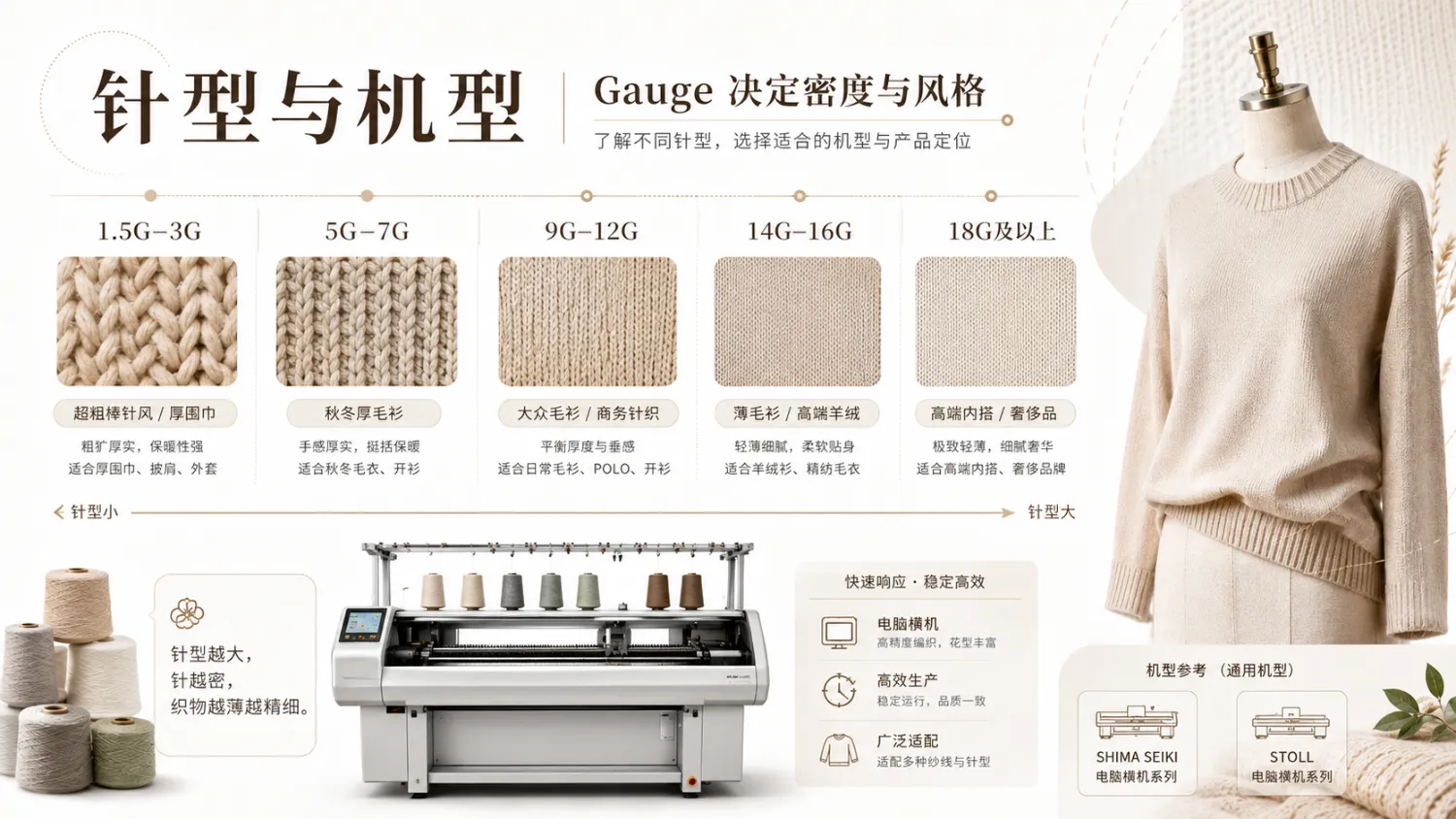
Gauge (GG) refers to the number of needles per inch on the knitting machine needle bed — the core indicator of knitwear fineness and density.
| Gauge | Density Characteristic | Typical Products | Key Selling Point |
|---|---|---|---|
| 1.5GG – 3GG | Ultra-coarse, bold texture | Chunky hand-knit style, thick scarves, decorative pieces | Texture, thickness, handcrafted feel |
| 5GG – 7GG | Medium-coarse, puffy and warm | Fall/winter heavy sweaters, cable knits | Warmth, 3D texture |
| 9GG – 12GG | Medium-fine, most common | Everyday sweaters, business knitwear | Versatile for regular development and mass production |
| 14GG – 16GG | Fine, lightweight and refined | Lightweight sweaters, premium cashmere | Finely detailed, close-fitting, lightweight |
| 18GG and above | Ultra-fine, fabric-like | High-end inner layers, luxury items | Fine precision and premium feel |
The higher the gauge number, the denser the needles and the finer the fabric. In terms of machinery, the industry standard is computerized flat knitting machines (SHIMA SEIKI, STOLL, etc.), which can produce complex patterns, automatic widening/narrowing, and whole garment knitting.
Garment Making
Different garment-making methods correspond to different design freedom, quality, material waste, equipment requirements, and cost positioning.
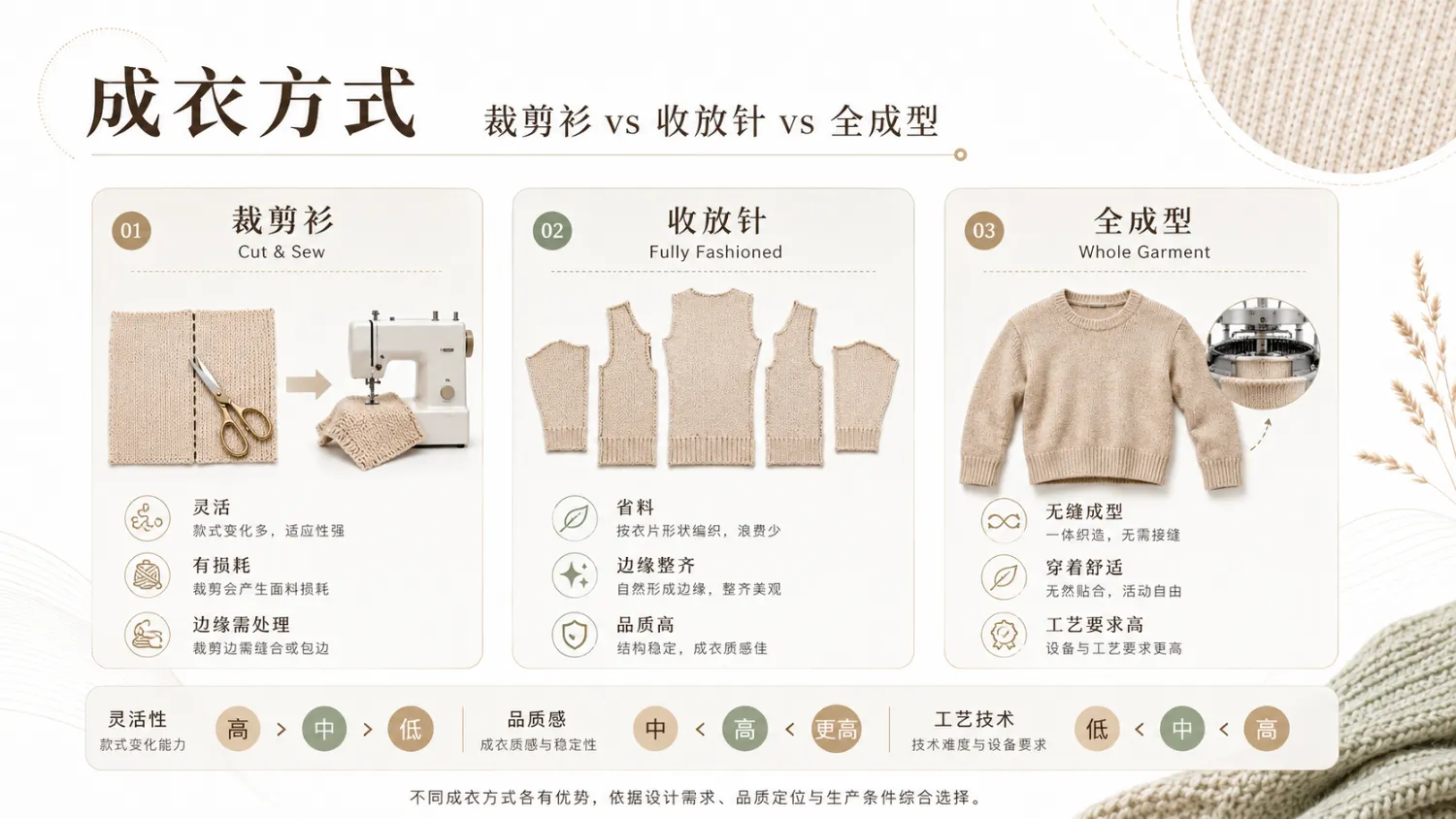
Cut & Sew
Large fabric panels are knitted first, then cut and sewn according to pattern. Flexible styling but generates fabric waste; edges require finishing.
Fully Fashioned
Garment panels are shaped during knitting by increasing or decreasing stitches. Clean edges, minimal waste, superior garment quality.
Whole Garment
The entire garment is knitted seamlessly in one piece. No linking seams, a seamless wearing experience. Highest technique and equipment requirements.
Whole Garment knitting represents the premium direction of knitwear manufacturing and can be matched flexibly according to the client's cost, quality, and capacity requirements.
Patterns & Shrinkage
The essence of pattern making is translating design measurements into stitch counts and course numbers that the machine can execute, while pre-compensating for shrinkage after washing and setting.
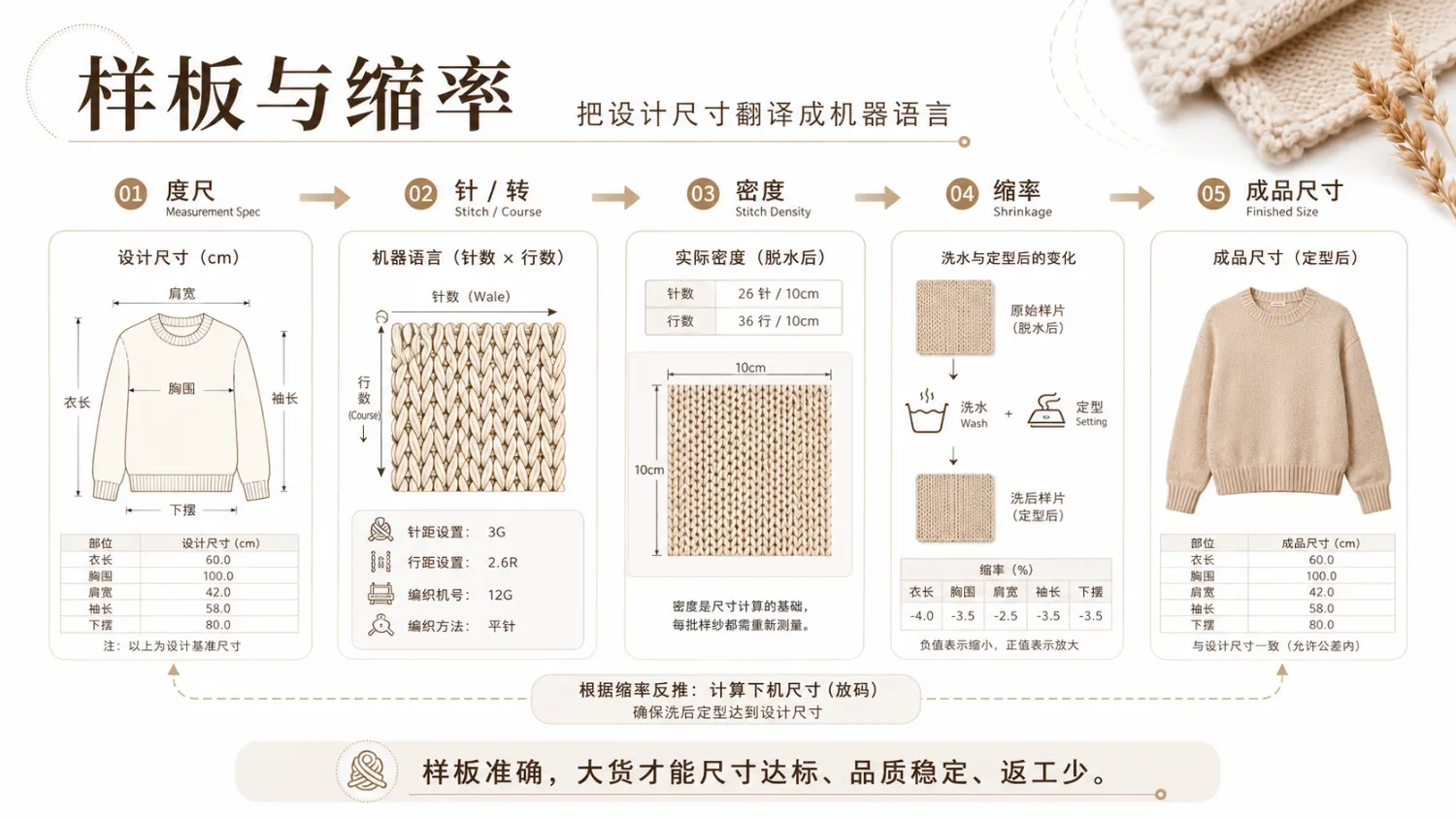
Measurement Spec → Machine Language
Design measurements like length, chest, shoulder, sleeve, and hem need to be converted into stitch counts, course counts, and density parameters.
Shrinkage → Reverse Calculation
Dimensions change after washing, milling, and setting. The pattern must pre-allow for shrinkage to ensure the finished garment meets target measurements.
| Key Concept | Also Known As | Meaning & Function |
|---|---|---|
| Measurement Spec | 度尺 | Specifies key dimensions: length, chest, shoulder, sleeve, hem, etc. — the basis for sampling and QC. |
| Stitch / Course | 针 / 转 | Knitting uses "stitches" (horizontal) and "courses" (vertical) as units. Patterns must accurately convert measurements to stitch and course counts. |
| Shrinkage | 缩率 | The dimensional change in fabric after washing, milling, and setting. The pattern must pre-compensate for shrinkage to ensure bulk garments meet spec. |
| Stitch Density | 密度 | The number of stitches and courses per unit area — the foundation of measurement conversion and weight control. |
Finishing & Quality Control
Finishing determines the final hand feel and appearance. QC ensures every delivered garment is consistently reliable.
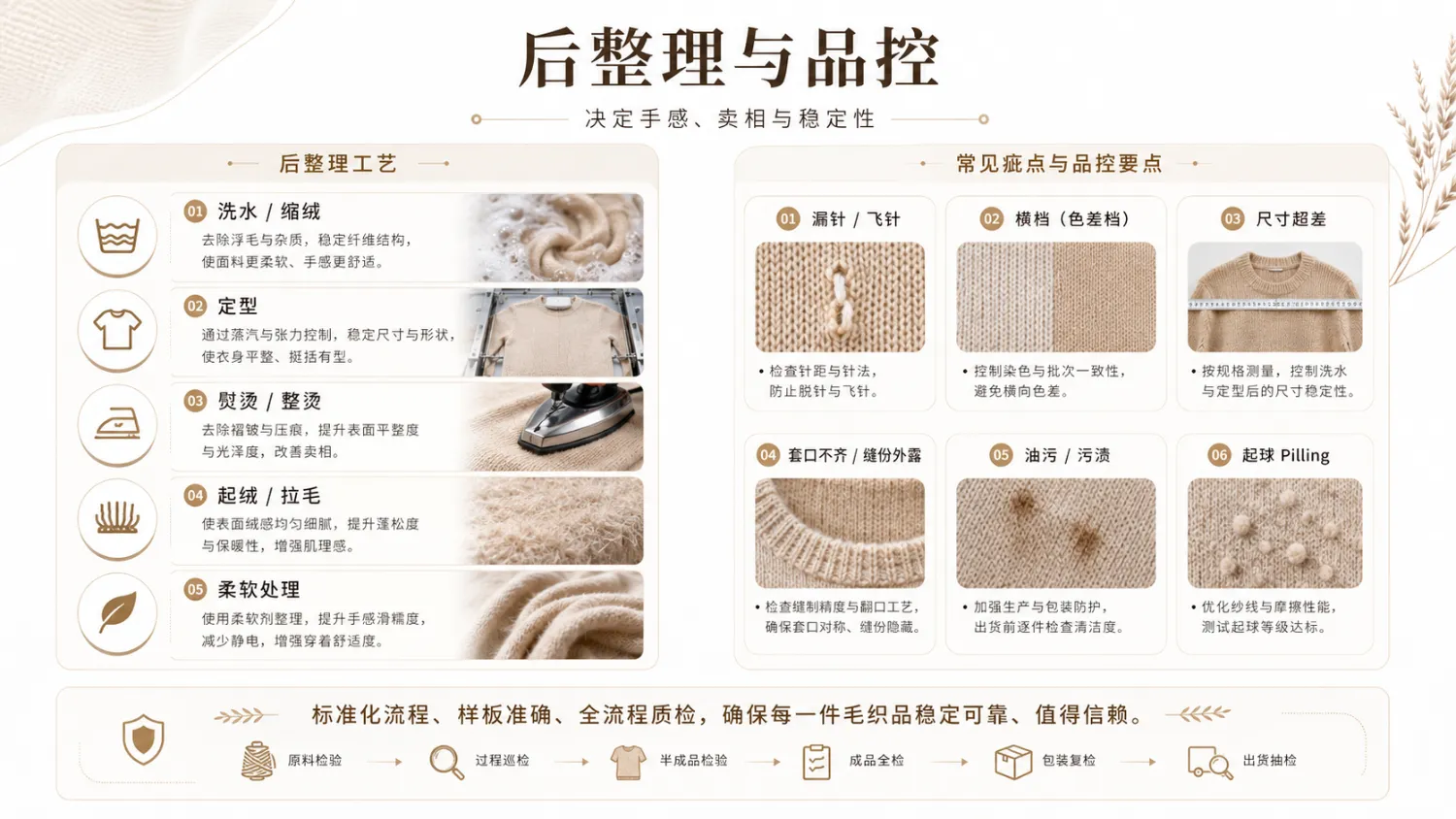
Washing / Milling
Washing / Milling: Water treatment shrinks and stabilizes loops. Some styles aim for a fluffy, soft hand feel.
Setting
High-temperature steam setting fixes dimensions and shape.
Pressing / Ironing
Flattens appearance, regularizes dimensions — ensuring the finished product meets shipping standards.
Brushing
Raises surface fibers, increasing softness and warmth.
Softening
Softener treatment enhances hand feel and skin-friendliness.
| Common Defect | Description |
|---|---|
| Dropped Stitch / Miss | Loops are lost or misaligned, causing holes or defects. |
| Barré (Horizontal Band) | Horizontal color or texture bands caused by yarn lot or tension variation. |
| Out-of-Tolerance Size | Finished dimensions deviate from the measurement spec tolerance. |
| Uneven Linking / Visible Seams | Joining areas are crooked or stitching is conspicuous. |
| Oil Stains / Soiling | Marks from handling during production and transport. |
| Pilling | Surface fuzz balls from abrasion, affecting appearance and durability. |
A well-developed pattern and standardized process reduce defect rates and rework costs from the source.
Knitwear Terminology Glossary
The most common terms used in purchasing, design, sampling, and quotation communication — searchable for quick reference.
| Term | English / Also Known As | Meaning |
|---|---|---|
| Knitwear / Sweater | Knitted Garment | Garments formed by knitting yarn into loops, commonly sweaters, cardigans, knit dresses, etc. |
| Flat Knitting Machine | Computerized Flat Bed | The primary equipment for knitting sweaters, forming panels or complete garments on a needle bed. |
| Whole Garment | Seamless Knitting | The entire garment is knitted seamlessly in one piece for superior comfort. High technique and equipment requirements. |
| Fully Fashioned | Shaped Knitting | Garment panels are shaped by increasing or decreasing stitches at edges. Clean edges, less waste, better quality. |
| Linking | Looper / Linking Machine | Joining garment panels stitch-by-stitch using a linking/looping machine — common for shoulder, sleeve, and neck seams. |
| Gauge / GG | Needles per Inch | The number of needles per inch on the needle bed — determines fabric fineness, coarseness, style, and suitable yarn. |
| Yarn Count / Nm | Metric Count | An indicator of yarn fineness. Commonly expressed in metric count (Nm). Within the same type, a higher number means finer yarn. |
| Measurement Spec | Size Spec / 度尺 | A specification of all key garment measurements — the common reference for sampling, bulk production, and QC. |
| Stitch / Course | Needle / Row | Horizontal units are "stitches"; vertical units are "courses" or "rows" — the language of machine knitting. |
| Shrinkage | Dimensional Change | The percentage change in fabric dimensions after washing, milling, and setting. |
| Stitch Density | Tightness Factor | The number of stitches and courses per unit length/area — foundation for measurement conversion and weight control. |
| Rib | Ribbing | Vertical alternating ridge structure with high elasticity, commonly used for collars, cuffs, and hems. |
| Jacquard | Fair Isle | Pattern formed using multiple yarn colors or structure variations. High pattern expression capability. |
| Intarsia | Color Block Knitting | Color block technique where each color area is knitted separately — no long floats on the reverse. Suitable for large graphic motifs. |
| Cable | Twisted Rope / Aran | 3D twisted rope texture, commonly used in fall/winter heavy sweaters and classic Aran-style garments. |
| Pointelle / Eyelet | Openwork | Small holes arranged into patterns — lightweight and breathable, commonly used in spring/summer women's knitwear. |
| Pilling | Fuzzing | Small fiber balls formed on the fabric surface from abrasion — influenced by yarn, structure, finishing, and wear. |
| GSM / Weight | Grammage | Fabric weight per unit area or garment weight — affects thickness, cost, and wearing feel. |
No matching terms found. Try a different keyword.
Frequently Asked Questions
Common questions that come up most often in purchasing, design, and sampling communication — all gathered here.
What is the difference between wool and cashmere?
Wool comes from sheep — it's warm, resilient, and widely applicable. Cashmere comes from the undercoat of cashmere goats — the fibers are finer, lighter, and softer, with a higher price point and premium positioning. The right choice depends on the season, budget, hand feel, and customer positioning.
Is a higher gauge number always better?
No. A higher gauge means finer needles and typically a thinner, more refined fabric. But coarser gauges offer more texture and a substantial feel. "Better" depends on the style, yarn thickness, season, and cost requirements.
Why is the sample pattern so important?
The sample pattern validates the design measurements, yarn, structure, gauge, shrinkage, and finishing all at once. If the pattern is not accurate, bulk production is likely to produce out-of-tolerance sizes, inconsistent hand feel, and high rework rates.
What is a whole garment knitted sweater?
Whole garment is a technique where the entire garment is knitted in one piece on the machine. It reduces seaming, resulting in a more comfortable wearing experience and a cleaner appearance — but requires higher equipment, programming, and technique standards, and usually comes at a higher cost.
Can pilling be completely avoided?
It is very difficult to eliminate completely. Pilling is affected by yarn composition, fiber length, twist, fabric structure, finishing treatments, and friction during wear. The risk can be reduced through careful yarn selection, structure design, and pilling resistance testing.
Put Your Knowledge to Work on Your Products
Send us your design drawings, reference photos, size charts, or target price points. We will advise on yarn, structure, gauge, pattern making, and production methods — using standardized patterns to control every technique node.