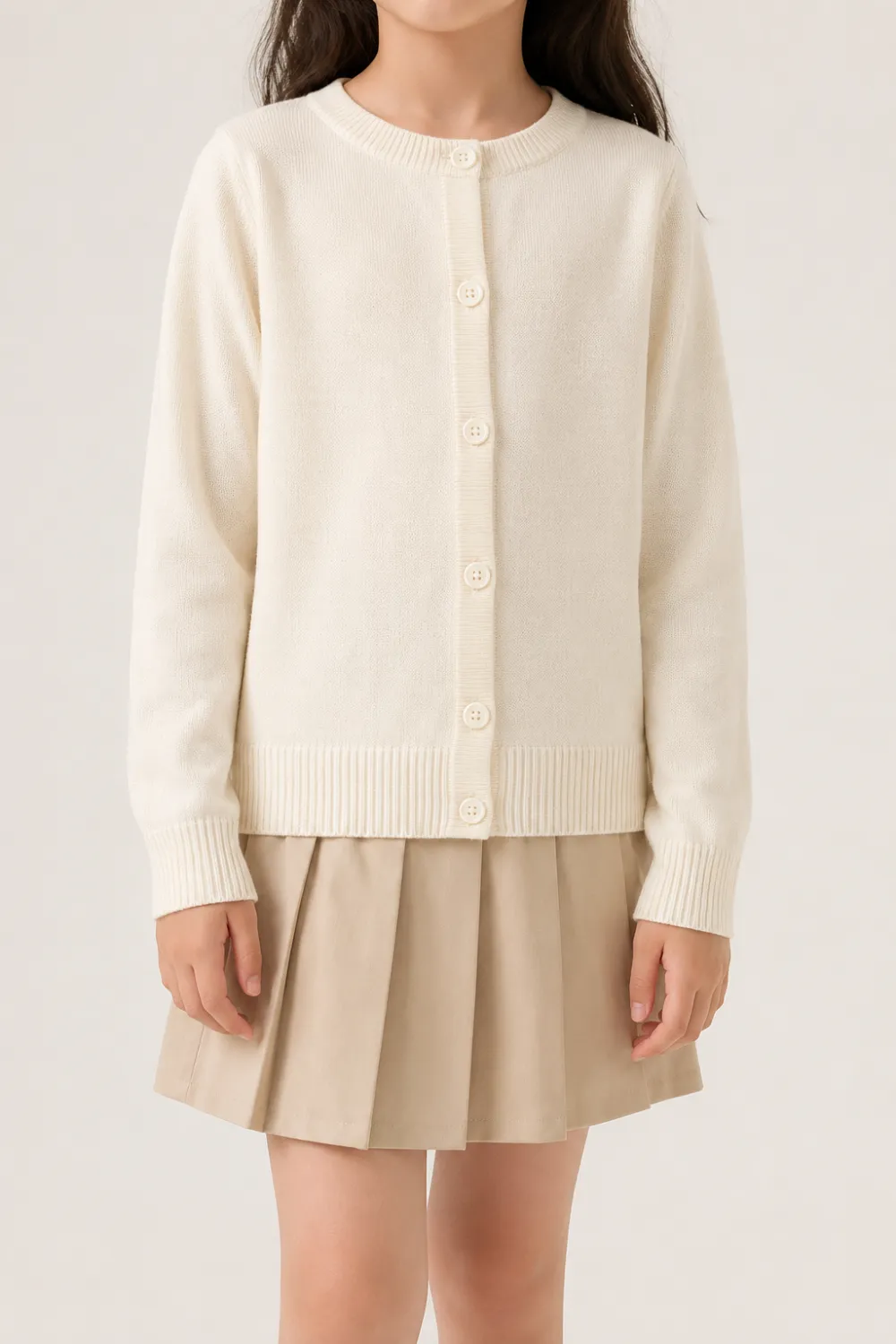
Children's knitwear may look smaller than adult garments, but it is considerably more complex to produce.
Many factories that handle adult knitwear are reluctant to take on children's orders for straightforward reasons: children's sizing spans a wide range (from infants to teenagers, each requiring separate grading), safety requirements are stringent (with different compliance standards, tensile tests, and flammability tests for different markets), and unit prices rarely match adult apparel levels.
Yet children's knitwear has the highest repurchase rate of any sweater category — children outgrow their sizes every year, and buying two or three new sweaters each seasonal transition is the norm. Brands that find a reliable children's knitwear factory can build a highly profitable long-term product line.
1. Children's Knitwear Product Characteristics — Fundamentally Different from Adult Apparel
Children's knitwear differs from adult knitwear in three fundamental ways:
| Dimension | Children's Knitwear | Adult Knitwear |
|---|---|---|
| Size range | From 2T (2 years) to 14Y (14 years), wide span | Relatively fixed — S-3XL / 46-58 |
| Safety requirements | Strict — CPSIA / EN 14682 drawstring standard / flammability testing | General — basic labeling compliance only |
| Reorder rate | Very high — children outgrow sizes yearly, repeat styles possible | Moderate — style-driven |
| Price sensitivity | Moderate — parents willing to spend more, but with limits | Varies by demographic |
| Fit preference | Loose fit, room for growth | Fitted as primary |
The most critical factor is safety compliance. In the US and EU markets, children's garment compliance is far stricter than adult wear. If a factory has no experience exporting children's garments, it may not even be familiar with basic CPSIA lead content and phthalate testing requirements.
2. Children's Sweater Sizing — Prepare at Least 7 Size Gradings
Adult sweaters typically need just 4-5 sizes. Children's sizing requires many more grades. Even if you only target ages 2-14, at least 7 sizes are recommended:
| Age | Size Label | Chest (cm) | Length (cm) | Target Market |
|---|---|---|---|---|
| 1-2 years | 2T / 90 cm | 54-56 | 33-36 | US/EU/Asia |
| 3-4 years | 4T / 100 cm | 57-59 | 37-40 | US/EU/Asia |
| 5-6 years | S / 110 cm | 61-63 | 41-44 | US/EU/Asia |
| 7-8 years | M / 120 cm | 65-68 | 45-48 | US/EU/Asia |
| 9-10 years | L / 130 cm | 70-73 | 49-52 | US/EU/Asia |
| 11-12 years | XL / 140 cm | 75-79 | 53-57 | US/EU/Asia |
| 13-14 years | 2XL / 150 cm | 80-85 | 58-63 | US/EU/Asia |
Each size grade for children's knitwear must be independently graded — simple proportional scaling does not work. Children's body proportions differ from adults: the head is proportionally larger, limbs are relatively shorter, and the belly protrudes more. Garments graded using adult scaling logic will fit poorly on children.
3. Children's Knitwear Safety Compliance — Three Essential Hurdles for Export
Compliance is a hard requirement for exporting children's knitwear to the US and EU. Goods that fail testing can be detained by customs or returned by retailers.
3.1 US Market (CPSIA)
- Total lead content: Children's products ≤100 ppm (may be relaxed to 300 ppm for ages 12+)
- Phthalates: ≤0.1% (8 restricted substances)
- Small parts testing: For children under 3, removable parts such as buttons and zipper pulls must pass 16 CFR 1501 small parts test (pull force ≥15 lb)
- Tracking label: Must include manufacturing date, batch number, factory address, and other information
- Flammability: 16 CFR Part 1610 — flammability classification for general wearing apparel
3.2 EU Market (EN 14682 etc.)
- Drawstring safety: Drawstrings in children's upper garment hoods are banned in the EU (choking hazard); any cord exceeding 14 cm poses a risk
- REACH regulations: Management of chemical substances, including azo dyes, nickel release, etc.
- CE marking: Mandatory certification for EU market access; manufacturer must issue a declaration of conformity
- OEKO-TEX Standard 100: Not legally mandatory, but commonly required by European retailers
💡 A common compliance pitfall: Many factories can produce high-quality adult knitwear but have no awareness of children's garment compliance. When sourcing children's knitwear for export, ask the factory for recent third-party test reports (SGS / Intertek / BV) and clearly specify compliance clauses in the contract.
4. Which Yarn Is Best for Children's Knitwear?
Yarn selection for children's knitwear differs from adult wear — safety, comfort, and washability are the three core considerations:
| Yarn Type | Hand Feel | Approx. Cost (300 pcs) | Best For |
|---|---|---|---|
| 100% Combed Cotton | Soft, breathable, skin-friendly | $6-10 | Next-to-skin wear, spring/summer, sensitive skin |
| Cotton/Acrylic Blend (50/50) | Soft with stretch, minimal shrinkage | $5-8 | Everyday wear, best value, durable |
| Wool/Nylon Blend | Warmth, shrink-resistant | $9-14 | Fall/winter, thermal-focused |
| Merino Wool | Ultra-soft, non-itchy | $12-18 | Mid-to-high-end children's, next-to-skin winter wear |
| Organic Cotton | Eco-friendly, no pesticide residue | $8-14 | Eco-brands, baby & maternity lines, premium positioning |
Two special considerations for children's knitwear yarn:
- Pilling — Children are active and garments experience more friction. Pure cotton pills less but deforms more easily; cotton-acrylic blends offer better anti-pilling performance.
- Shrinkage control — Parents tend to wash children's clothes at higher temperatures. Request shrinkage testing from the factory (measure before washing → measure after washing; control shrinkage to ≤5%). Re-test whenever the yarn batch changes for bulk production.
5. Factory Selection Criteria
5.1 Export Compliance Experience First
Export compliance is the primary barrier for children's knitwear. These three questions can quickly filter potential factories:
- "Have you produced children's knitwear exported to the US or EU? Do you have CPSIA or REACH third-party reports?"
- "Are you familiar with EN 14682 drawstring restrictions? Can children's garments use elastic hems?"
- "Will you randomly sample bulk production for third-party testing? Who covers the cost?"
If a factory is unclear on any of these questions, consider a more experienced supplier.
5.2 Pattern Development Capability
Children's pattern development is a separate discipline from adult wear. A strong children's factory should offer:
- Size charts grouped by age range — infants (12M-24M), toddlers (2T-5T), children (S-XL)
- Grading recommendations — smooth size transitions between each age group
- Growth allowance — an extra 2-4 cm of ease beyond the fitted measurement
5.3 Production Capacity and Service
For more on factory workflows and capacity, see our Complete Guide to Knitwear Sample Customization. Linknit, with over 20 years of experience as a knitwear manufacturer, operates with an MOQ of approximately 300 pieces, sampling in 6-10 days, and bulk production in 18-25 days. We have mature production experience across women's sweaters, men's sweaters, and children's knitwear.
6. Frequently Asked Questions
Do children's knitwear orders have a lower MOQ?
Not necessarily. Children's garments typically require more SKUs (color × size) than adult wear, so the total MOQ may not be lower. However, some factories accept "mixed MOQ" — combining different colors of the same style to meet the minimum. For more on MOQ, see Bulk Ordering and MOQ Guide for Sweaters.
What are the differences between US and EU standards for children's knitwear?
The US emphasizes lead content and small parts pull testing (CPSIA), while the EU focuses on drawstring safety (EN 14682) and chemical substance control (REACH). Both sets of standards require passing respective tests. Look for factories with SGS or Intertek third-party reports.
Can we customize brand labels on children's knitwear?
Yes. Brands can customize care label information, as well as hang tags, woven labels, and printed labels. Children's size hang tags are often designed to be more playful and colorful to match the brand positioning. For more on labeling requirements, see our Sweater Export Compliance Guide.
Can children's knitwear use the same yarn as adult apparel?
Yes, but with two caveats: first, the yarn should carry OEKO-TEX Standard 100 certification (required by many Western retailers), and second, choose yarns with low pilling tendency and low shrinkage rates. Children's garments are washed more frequently than adult wear, making washability a critical factor.
Summary: Children's knitwear is a high-repeat-purchase category, but it demands significantly more compliance expertise and pattern development capability from factories than adult wear. When selecting a factory, prioritize export compliance experience over price and lead time.
Looking for a factory for your children's knitwear line? Feel free to contact us for a free consultation and quote. Also read our Women's Knitwear Sourcing Guide and Men's Knitwear Sourcing Guide for a comprehensive understanding of factory selection across different categories.