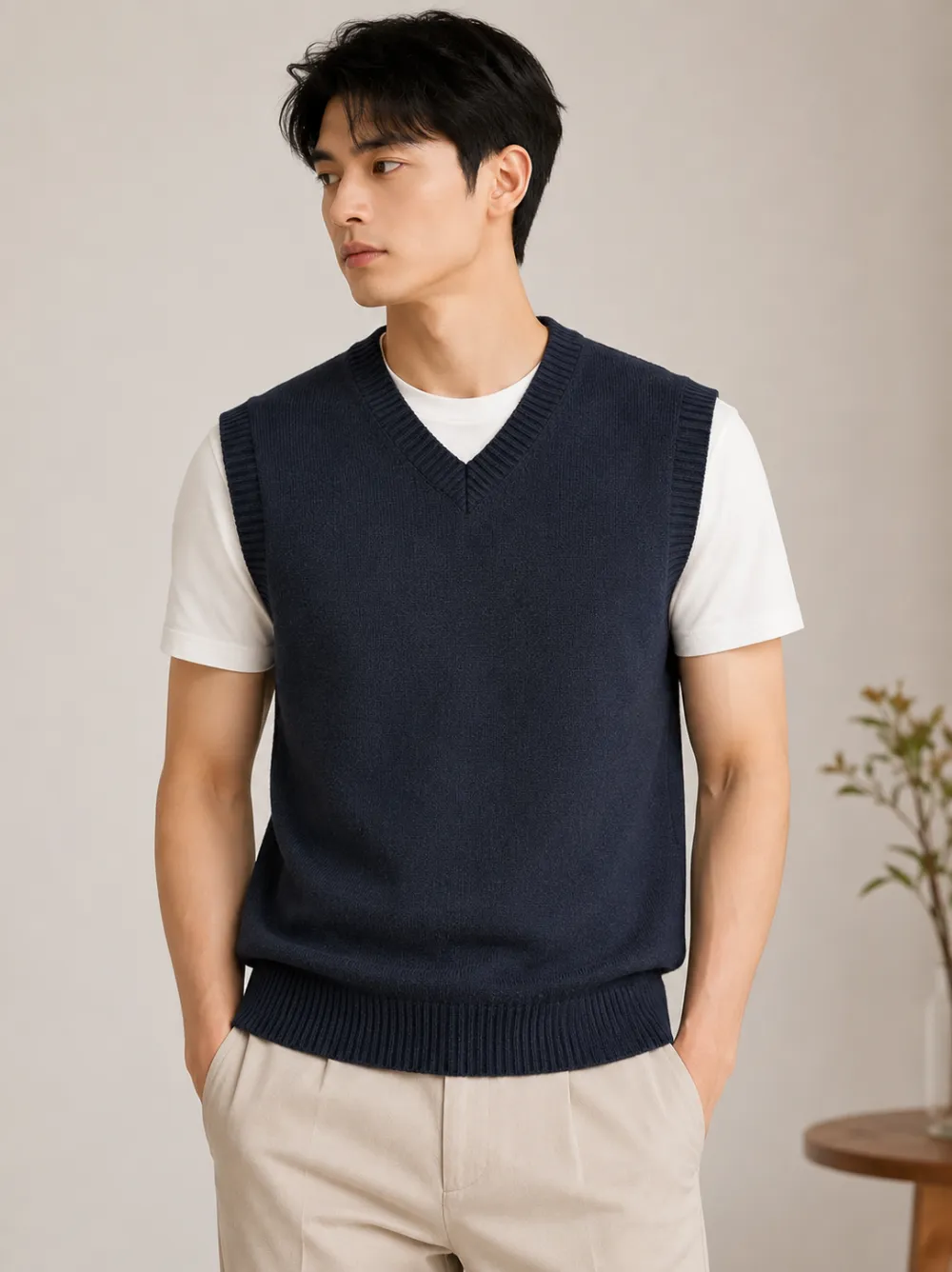
Knit vests seem like the simplest knitwear category — no sleeves, no collar. But precisely because they're simple, every detail flaw is magnified.
An uneven neckline, a hem that doesn't snap back, a misaligned side seam — on a pullover sweater these might not be obvious. But on a vest, with so little fabric, every imperfect detail has nowhere to hide.
When brands source knit vests, they're ostensibly looking for a manufacturer, but they're really looking for a factory that can perfect these "small details."
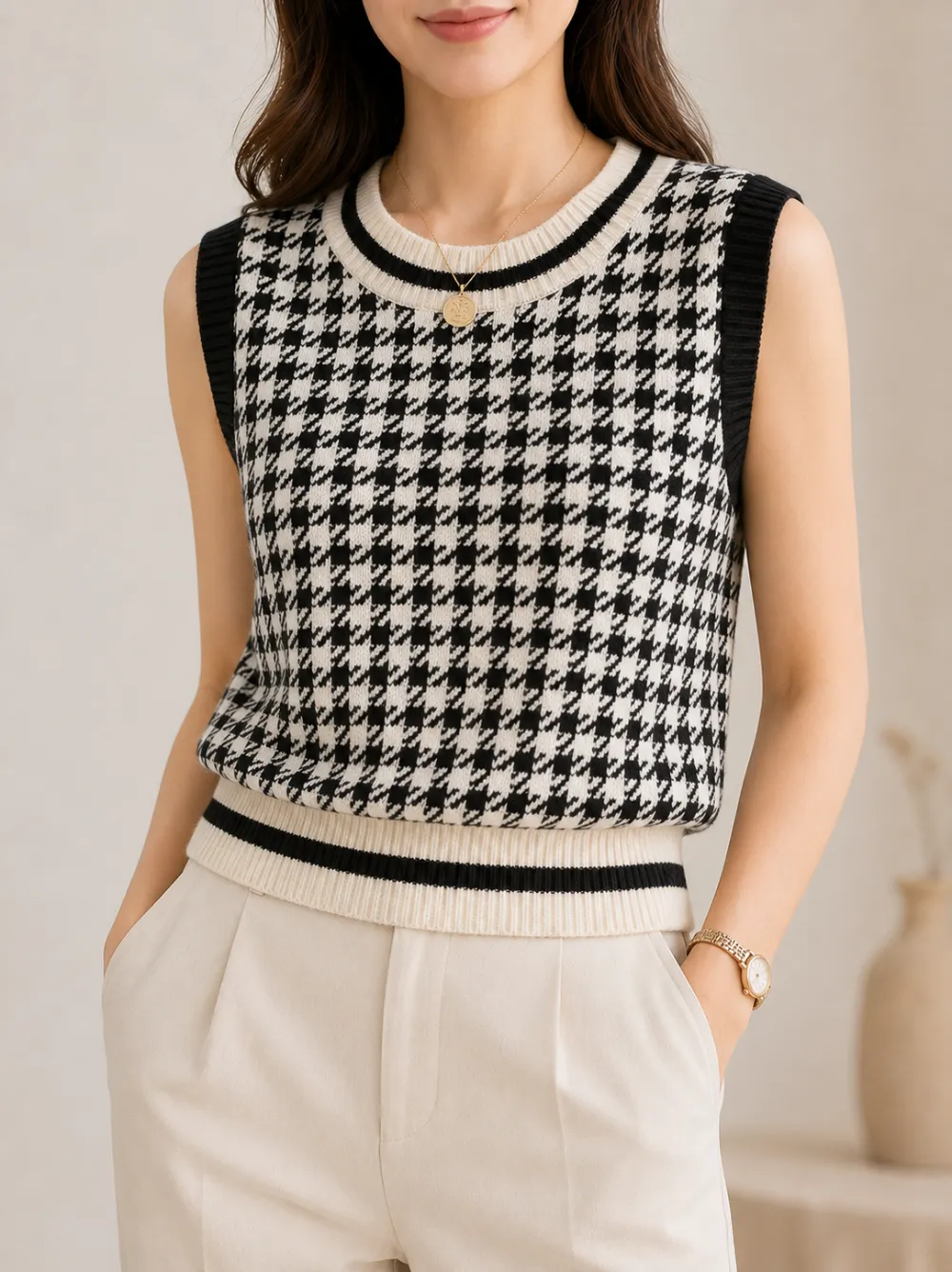
1. What Are the Main Knit Vest Categories?
Knit vests may appear homogeneous, but they have clear application scenarios:
| Category | Gauge Range | Application | Styling |
|---|---|---|---|
| V-neck pullover vest | 7G–12G | Business layering/casual wear | Wear over shirt/base layer, either as outerwear or inner layer |
| Crew neck basic vest | 9G–14G | Daily layering | Outerwear in spring/fall, inner layer in winter |
| Suit waistcoat | 5G–7G | Business formal/formal wear | Three-piece suit set; extremely high neckline and hem requirements |
| Sporty knit vest | 3G–5G | Outdoor/casual | Chunky knit, often paired with hoodies or casual pants |
| Women's fitted vest | 12G–16G | Commute/dating | Thin, next-to-skin; often in fancy yarns or cable patterns |
| Preppy V-neck vest | 7G–9G | Campus/casual | Classic argyle or solid color, paired with shirt |
Among these, the V-neck pullover vest has the largest order volume, accounting for approximately 40% of knit vest orders. Meanwhile, suit waistcoats have smaller order volume but the highest unit price and profit, with the most demanding craftsmanship requirements.
2. Three Major Craft Challenges in Knit Vests
2.1 Neckline Craftsmanship — The "Soul" of the Vest
With no sleeves, the neckline is the visual focal point. A well-executed neckline determines whether the vest looks "refined" or "cheap."
Common neckline techniques:
- Tubular collar: The most common machine-knit collar; good elasticity and flatness, suitable for most vests
- Hand-linked collar: Hand-stitched binding, complex process, low efficiency, but the most refined result, commonly used in high-end suit waistcoats
- Banded collar: A separately knitted rib band sewn on; good elasticity, suitable for casual vests, but slightly less flat
- Seamless stitch shaping: Stitches are shaped directly on the body panel to form the neckline; the most integrated look, but requires high precision from the knitting machine
What brands should watch: Does the rib material used for the neckline match the body? If the rib uses different yarn (common practice: cotton/nylon rib blend with a pure wool body), the shrinkage and colorfastness may differ, causing neckline distortion or color difference after multiple washes.
2.2 Hem and Armhole Shaping — Details Easily Overlooked
The vest's hem and armhole also have nowhere to hide. A good knit vest has a hem that snaps back firmly and edges that are flat and clean. A poor vest has a loose hem and curled edges.
Key control points:
- Hem ribbing should be 2–4 cm smaller than the body — this creates an inward gathering effect
- Armhole curve stitch shaping should be even — the spacing between each stitch point must be consistent, otherwise the armhole edge will look wavy
- Steam setting must be thorough — focus on the armhole and hem areas during finishing
For a complete quality control system, refer to Complete Guide to Knitwear Quality Inspection Standards.
2.3 Placket Craftsmanship (Open-Front Waistcoat Styles)
For button or zip-front styles, placket flatness is the biggest challenge.
- Button waistcoat: The placket naturally experiences stretching from the body's weight; anti-stretch treatment (tape or inner reinforcement) must be added at the design stage
- Zip-front waistcoat: The zipper must be installed precisely in the center; the rib shrinkage on both sides of the zipper needs to be consistent, otherwise the zipper will curve into an arc
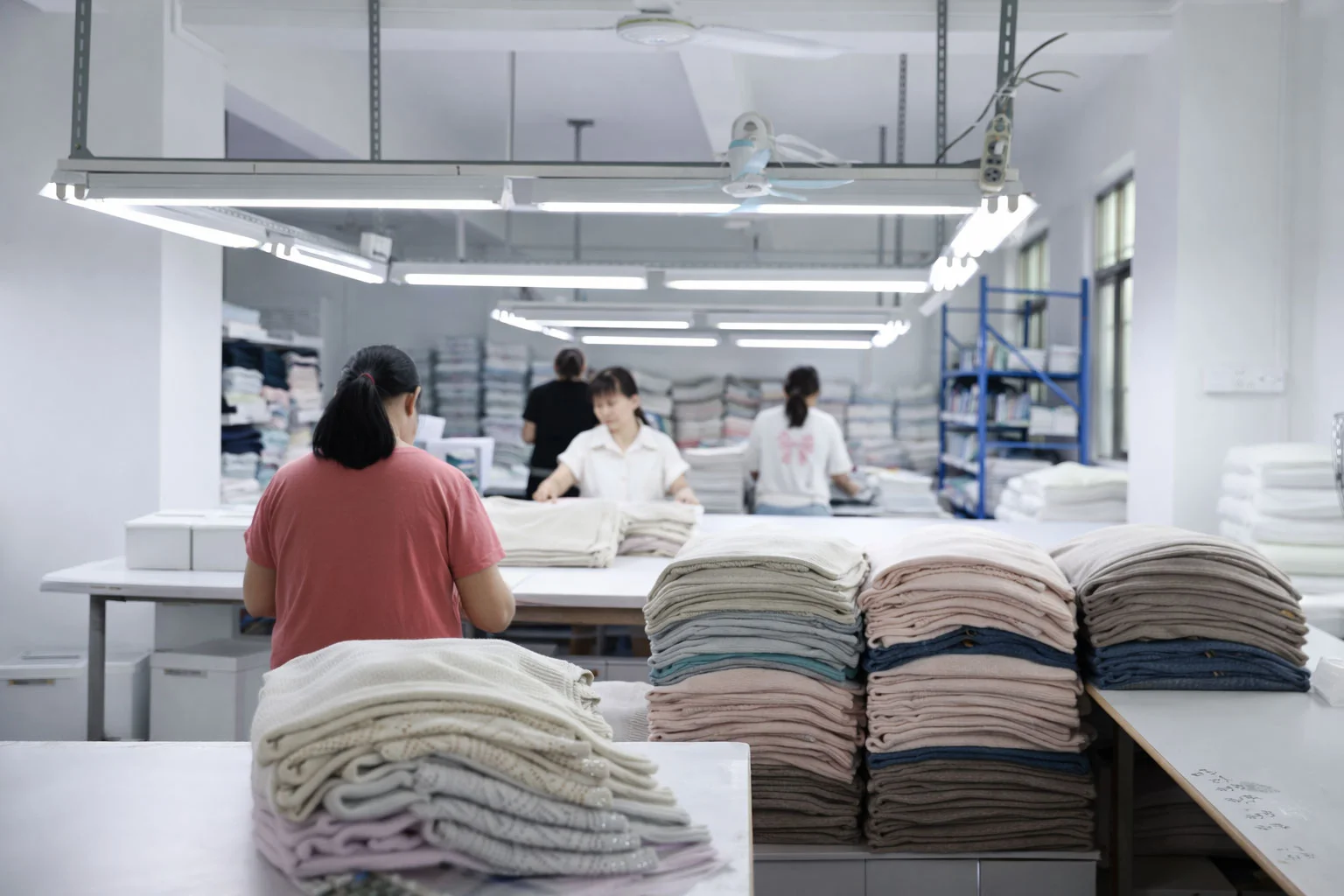
3. Common Gauge and Yarn Matching for Knit Vests
The choice of gauge and yarn for vests depends more on wearing style and season:
| Wearing Style | Recommended Gauge | Recommended Yarn | Season |
|---|---|---|---|
| Next-to-skin layering | 12G–16G | Combed cotton, Merino wool, cashmere blend | Spring/Summer, Spring/Fall |
| Over-shirt layering | 7G–12G | Pure wool, cotton-wool blend, acrylic/cotton | Spring/Fall, early winter |
| Outerwear/heavy style | 5G–7G | Pure virgin wool, alpaca blend, woolen fancy yarn | Fall/Winter, Winter |
| Suit waistcoat | 5G–9G | Worsted wool, wool/silk blend | All-season/business |
Brand material tip: Vests use less material than pullovers (about 30%–40% less), so even when using premium yarns (like cashmere, silk blends), the absolute cost increase per piece is manageable. If a brand wants to differentiate in the vest category, upgrading the yarn is the most direct strategy. For cost comparisons across different yarns, refer to Wool, Cashmere & Blend Cost Guide.
4. Vest Fit Essentials
Vest fit comes down to three relationships:
1. Shoulder width vs Chest circumference: The vest's "shoulder point" position determines the visual silhouette. Broader shoulders look casual; narrower shoulders look formal. A standard fit has the shoulder point 2–4 cm inward from actual shoulder width; 4–6 cm is a slim fit; no reduction is a relaxed fit.
2. Neckline depth vs Body length: V-neck depth directly affects how much shirt is visible when layering. Business V-neck depth is 18–20 cm; casual depth is 20–24 cm. With the same V-neck depth, a shorter body length creates a taller visual appearance, while a longer body length leans more casual.
3. Armhole size vs Side seam: If the armhole opening is too large, the waistline is visible from the side — unsightly. If too small, it's uncomfortable to wear. Standard armhole depth is 20–24 cm (depending on size). For specific fit parameters, discuss in detail with the factory during the Tech Pack stage. Refer to Tech Pack Knitwear Development Guide.
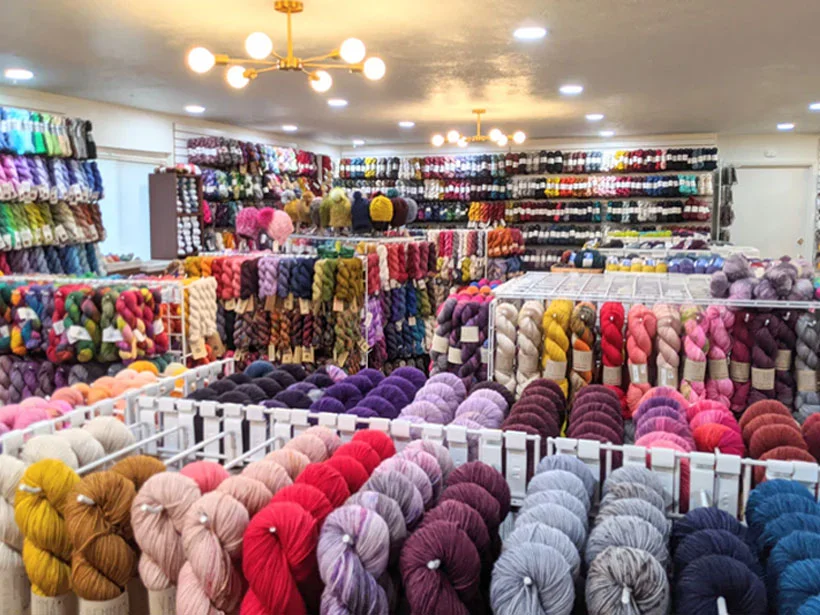
5. Factory Selection Criteria for Knit Vests
5.1 Five Questions to Ask a Factory
1. Do your vests' neckline and body have the same shrinkage rate?
This is the most common issue. If the neckline rib and body yarn have different shrinkage rates, the neckline will wrinkle or flip outward after the first wash. A good factory will conduct pre-shrinkage tests to ensure the rib and body match.
2. How many stitches do you reduce for the armhole? How do you ensure evenness?
A vest with uneven armhole stitch reduction looks like a shirt collar that hasn't been properly turned out. Factories should use automatic stitch reduction programs rather than manual operation by feel.
3. How much smaller is the hem ribbing compared to the body?
The standard is 2–4 cm smaller than the body. If a factory says "the same size," it shows they lack fit control expertise in the vest category.
4. Do you reinforce the placket of button waistcoats?
Professional factories add tape reinforcement or dense knitting inside the placket to prevent sagging from button pull.
5. Can you make creative vests, like uneven hems or side slits?
Factories that can handle creative styles have stronger pattern-making capabilities. If a factory only makes standard styles, their development ability is limited. For creative style sampling processes, refer to Knitwear Sampling Customization & Sample Development Guide.
5.2 Why Choose Linknit for Knit Vests?
Linknit has extensive production experience in the knit vest category, with stable capacity ensuring reliable delivery. Our core advantages:
- Precise stitch shaping — Uniform stitch reduction at armholes and necklines in the vest category is our craft strength
- Multi-gauge coverage — 3G–16G full coverage, from chunky casual styles to fine-gauge business styles
- Experienced pattern team — Familiar with domestic and international sizing standards; experienced in business waistcoats, preppy styles, and casual styles
For more about our factory, refer to Linknit Factory Full Profile.
6. Recommended Knit Vest Sourcing Process
- Define style and wearing scenario — Business layering, casual layering, or formal waistcoat? This determines the gauge and yarn direction
- Provide reference images or design drawings — Best to mark key dimensions like neckline depth and hem shape
- Select yarn and gauge — Match based on wearing style and budget; ask the factory to recommend 2–3 options
- Development sample approval — 6–10 days to produce; focus on neckline flatness, armhole curve, and hem snap-back
- PP sample approval — Bulk production process confirmation, including button/zipper accessory placement
- Bulk production + inspection — In-line and final inspection, focusing on neckline and armhole size consistency
Summary: Knit vests are "deceptively simple yet the hardest" — the simpler the style, the higher the demand on details. Neckline craftsmanship, hem shaping, and armhole stitch reduction — these three aspects determine a vest's quality level.
Need a manufacturer for your knit vest category? Welcome to contact us for a free consultation and quotation. Also read our Men's Knitwear Sourcing Guide for a broader understanding of men's knitwear factory selection.