Sweater OEM manufacturing and private label production are the most common supply chain approaches for brands and cross-border sellers. But finding the right factory is more complicated than it seems.
Not all knitwear factories are the same — some excel at small-batch fast turnaround, others focus on large-scale private label production, and some specialize in high-end cashmere. Choose wrong, and you'll face inflated quotes, delayed deliveries, or worse — quality failures and batch rejections.
This article starts from the fundamentals of OEM models to help you make more accurate judgments when searching for and evaluating factories.
Three OEM Models: OEM, ODM, OBM — Who Should Choose Which?
| Model | Brand Handles | Factory Handles | Best For |
|---|---|---|---|
| OEM (Original Equipment Manufacturing) | Provides design drawings, samples, size specs, process sheets | Produces to order, no development involvement | Brands with mature design teams, need production execution only |
| ODM (Original Design Manufacturing) | States needs and budget | Handles style development, sampling, and modifications | Brands without design capability, or looking to use factory's existing patterns |
| OBM (Original Brand Manufacturing) | Provides brand labels, packaging requirements | Production + partial packaging/labeling services | Startup brands or white-label sellers needing one-stop service |
How to Choose?

Five Key Dimensions for Selecting a Knitwear Factory
1. Production Capacity and Equipment
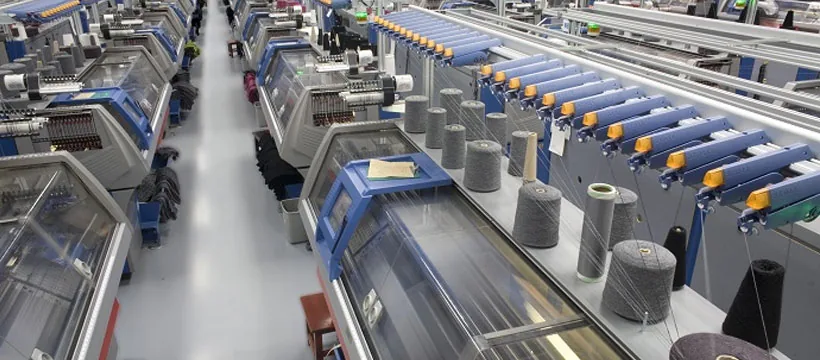
First, check the factory's number and types of computerized flat knitting machines — this directly determines the order size they can handle and the complexity of processes they can execute.
| Capacity Indicator | Small Factory | Medium Factory | Large Factory |
|---|---|---|---|
| Flat knitting machines | 10-30 units | 30-80 units | 80+ units |
| Monthly capacity | 5,000-15,000 pcs | 15,000-50,000 pcs | 50,000+ pcs |
| Gauge coverage | 3-5 types | 5-8 types | Full range 3G-18G |
| Suitable orders | Small batch testing | Regular reorders | Large-scale private label |
Small batches need small factories; large batches need large factories. Take a 500-piece order to a factory producing 100,000 pieces a month, and you won't get priority. Take a 50,000-piece order to a 10-machine factory, and their capacity simply won't support it.
2. Quality Control System
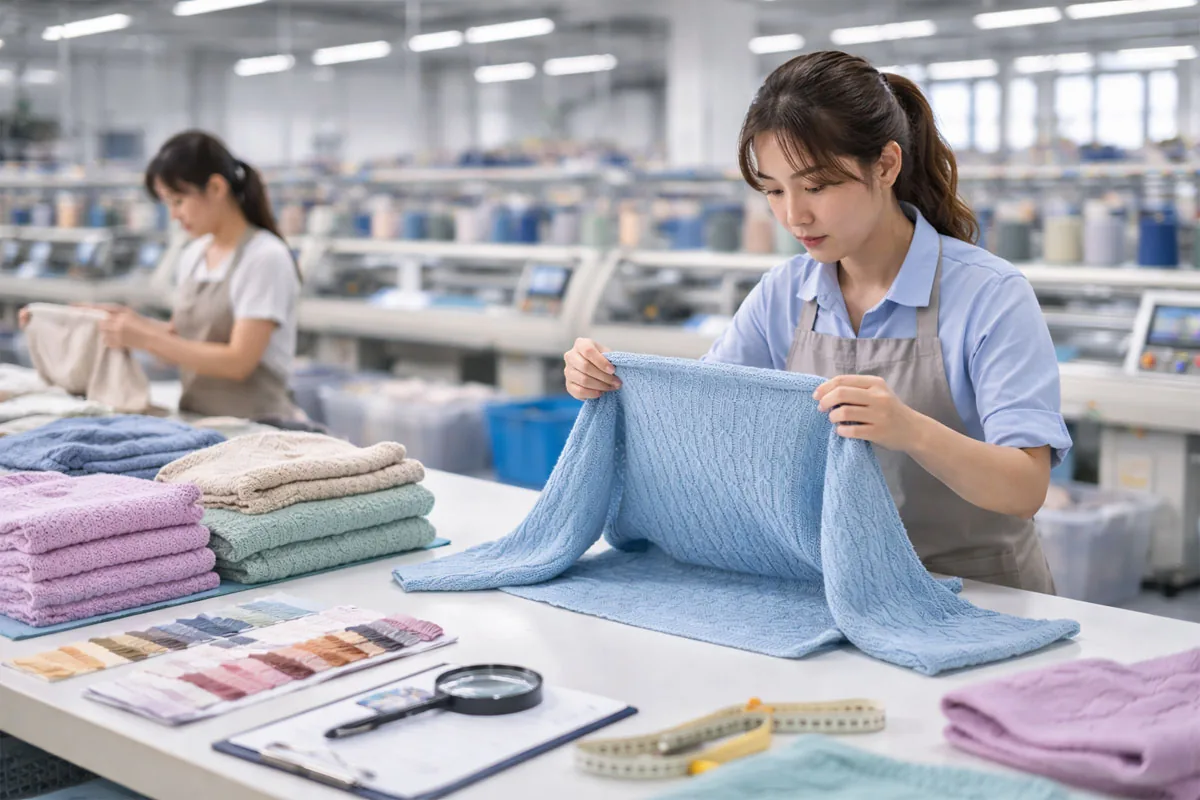
Most knitwear quality issues (pilling, shrinkage, color deviation, loose seams) originate in the QC process. Ask these three questions to eliminate half the candidates:
- Do you conduct in-house shrinkage and color fastness testing? (If not, it's purely experience-based)
- Is there a piece-by-piece inspection process during finishing? (Piece-by-piece vs. spot-check — the difference is an order of magnitude)
- What is your defect rate? (Industry average 3%-5%; below 2% is excellent)
3. MOQ and Lead Time
| OEM Type | Typical MOQ | Sampling Lead Time | Bulk Production Lead Time |
|---|---|---|---|
| Standard styles (12G/14G fine gauge) | 200-500 pcs per style | 7-10 days | 20-30 days |
| Complex styles (jacquard/intarsia/chunky) | 300-800 pcs per style | 10-15 days | 25-40 days |
| High-end cashmere styles | 200-500 pcs per style | 10-14 days | 25-35 days |
Note: During peak season (August-October for Fall/Winter), most factories' lead times extend by 1-2 weeks. It's advisable to lock in capacity at least 1 month in advance.
4. Certifications and Compliance
If your products are destined for Europe or the US, the factory's compliance status directly determines whether you can enter those channels:
- OEKO-TEX® Standard 100 — Textile harmlessness certification, basic requirement for the European market
- BSCI / Sedex — Social compliance audit, mandatory for European and American brands
- GRS (Global Recycled Standard) — Required for recycled yarn products
- GOTS (Global Organic Textile Standard) — Required for organic cotton/organic wool products
5. Communication Responsiveness
This is often overlooked, but communication efficiency during the sampling phase directly impacts the entire project pace. Ideal state:
- Requirements sent, feasibility assessment within 24 hours
- Preliminary quote within 3 days
- Dedicated point of contact during sampling — not "wait until the factory manager is free"
Pricing Logic: What Makes Up a Knitwear OEM Quote?
Understanding the cost structure helps you distinguish between "good value" and "hidden traps" when comparing quotes:
| Cost Item | Approximate Share | Description |
|---|---|---|
| Yarn cost | 40%-55% | Raw material, highly variable, directly impacts the quote |
| Knitting processing | 20%-30% | Machine hours + piecework labor |
| Finishing cost | 10%-15% | Linking, washing, pressing, inspection |
| Packaging and trims | 3%-5% | Hang tags, poly bags, cartons |
| Management + profit | 10%-15% | Factory's reasonable margin |
Price comparison tip: If two factories quote the same style, a difference of 10% or less is normal (due to equipment depreciation and management efficiency differences). If the gap exceeds 20%, the lower-priced factory may be cutting corners on yarn specs or finishing standards.
Four Recommendations for Brands and Cross-Border Sellers
- Sample first, then bulk order — never skip steps. No matter how convincing a factory sounds, let the samples speak. Sampling validates fit, process quality, and communication effectiveness.
- Build buffer into your order scheduling. Knitwear has clear seasonality — capacity is tight in Fall/Winter peak season (July-November) and relatively relaxed in Spring/Summer (February-May). Lock in peak season orders at least 6-8 weeks ahead.
- Confirm sealed sample standards before bulk production. After sampling approval, keep one approved sample as a sealed reference. Use it for comparison during bulk inspection — it's the most direct and effective quality baseline.
- Build long-term relationships. Knitwear factories generally prefer serving stable, long-term clients. After 2-3 seasons of continuous cooperation, the factory becomes familiar with your patterns, processes, and quality requirements. Communication costs drop significantly, and defect rates follow.
Frequently Asked Questions
What is the minimum order quantity for a knitwear factory?
It depends on style complexity and gauge. For basic fine-gauge sweaters (12G/14G), most factories accept 200-300 pcs per style. For complex jacquard or chunky styles, the minimum is typically 300-500 pcs. Some factories specializing in small-batch fast turnaround may accept as low as 100 pieces, but it's worth asking.
What's the difference between OEM processing and private label production?
In simple terms: OEM processing means you design and the factory produces to spec; private label (OBM) means the factory produces the goods and you put your brand label on them. With OEM you control design and quality; with OBM you skip development but rely on the factory's quality control capability.
How far in advance should I place a sweater OEM order?
Sampling 7-15 days → Confirmed production 20-35 days → Shipment (including logistics). Total recommended lead time: 30-45 days for summer, 45-60 days for Fall/Winter (peak season schedules run longer). For your first cooperation with a factory, add another 1-2 weeks for communication.
How do I tell if a knitwear factory is reliable?
Check four things: ① Can they sample — if they won't even provide samples, rule them out. ② Do they have a QC process — ask about shrinkage testing and piece-by-piece inspection. ③ Does their capacity match your order volume — small orders for small factories, large orders for large factories. ④ Is communication smooth — 24-hour response is the basic standard.
For more information on OEM/ODM cooperation, check out the complete comparison of OEM knitwear processing vs ODM sweater customization, or contact us directly to discuss your specific requirements.