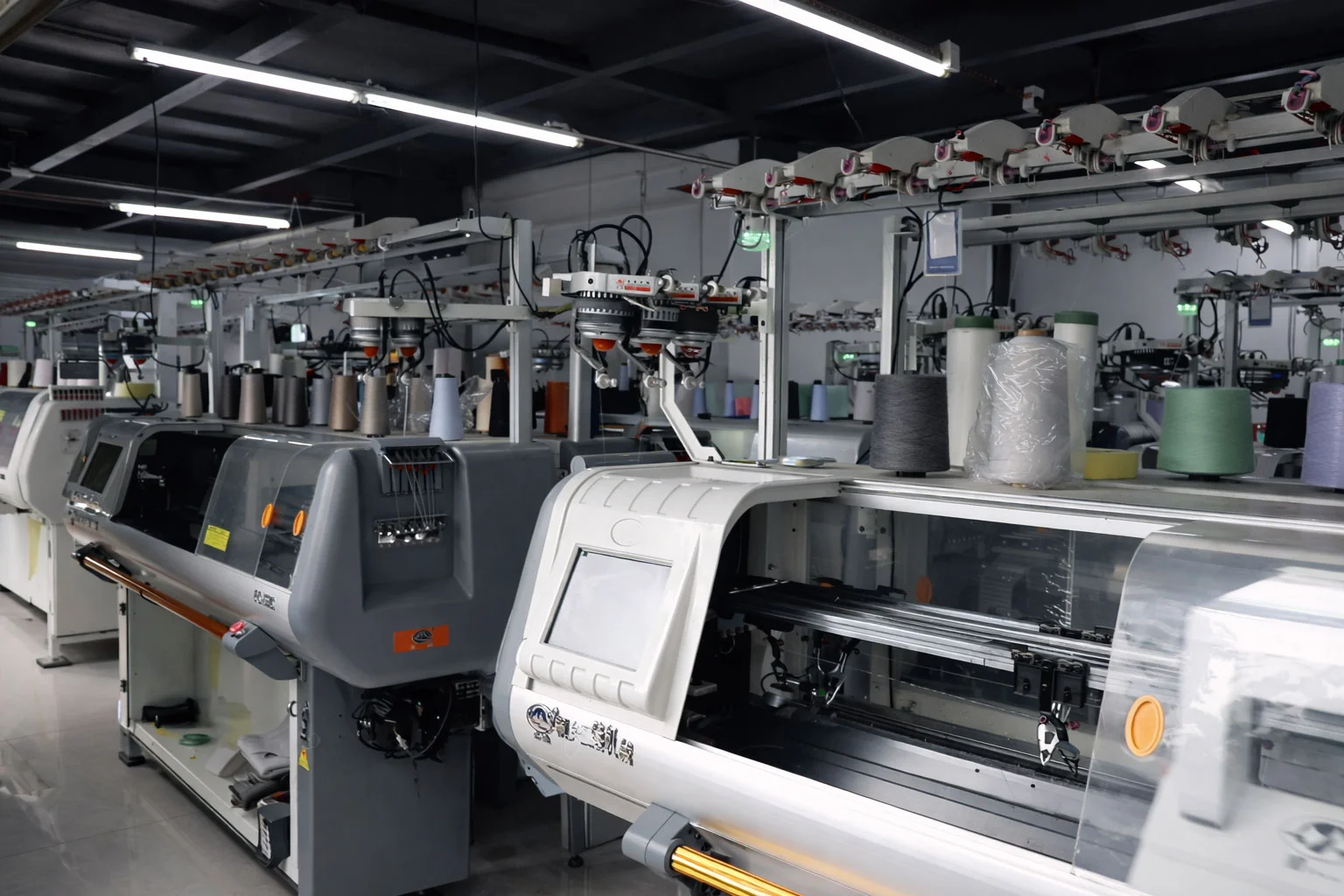
Adding letters or patterns to a sweater seems straightforward, but the technique you choose directly determines the final result.
Many brands receive samples and find — "Why do the edges of these letters look jagged?" or "Why doesn't the embroidered logo look more dimensional?"
These issues arise because each technique has inherent characteristics that shape the final outcome. Jacquard, embroidery, and patch all have their strengths and weaknesses, and each is suited to different applications. This guide helps you understand the differences before placing your order.
1. Jacquard — Pattern "Knitted Into" the Fabric
1.1 How It Works
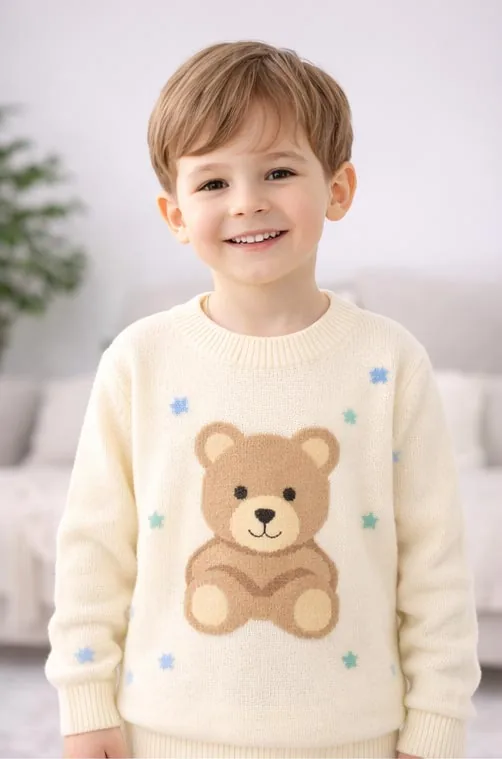
Jacquard is a technique in which different colored yarns are directly knitted into the fabric during the knitting process. The pattern is an integral part of the sweater itself, not applied afterward.
1.2 Why the Jagged Edge?
The nature of jacquard means that each row can only use one color of yarn. When a letter or pattern edge requires a curved or diagonal transition, the limited pixel density (determined by the machine gauge) means the curve is actually made up of a series of small "steps" — this is the source of the jagged appearance.
| Gauge | Jaggedness Level | Explanation |
|---|---|---|
| 3G–5G (coarse) | Pronounced | Large needle pitch, each step is wider |
| 7G–9G (mid) | Moderate | Moderate needle pitch, stepped effect acceptable |
| 12G (mid-fine) | Slight | Fine needle density, jaggedness barely visible |
| 14G–16G (fine) | Minimal | Densest needles, finest jacquard patterns |
Tip: If your design includes small text or a detailed logo, fine gauge (12G and above) produces the best jacquard results — the jagged effect is virtually invisible.
1.3 Jacquard Pros and Cons
| Advantages | Disadvantages |
|---|---|
| Pattern is integral to the fabric — won't peel off | Small/refined patterns show jagged edges |
| Machine-washable | Color changes limited (typically 4-5 colors max) |
| Won't fade or wear off over time | Complex jacquard on coarse-gauge sweaters significantly increases cost |
2. Embroidery — Pattern "Stitched On" After Knitting
2.1 How It Works
Embroidery uses an embroidery machine to stitch patterns onto the surface of a finished sweater. The key difference from jacquard: embroidery is "attached" to the fabric surface, while jacquard is "knitted into" the fabric structure.
2.2 Embroidery Pros and Cons
| Advantages | Disadvantages |
|---|---|
| Fine, clear edges with no jaggedness | Loose threads on reverse side; requires backing |
| Unlimited color choices | Not suitable for large-area coverage (stiffens the sweater) |
| Ideal for detailed text and logos | Embroidery threads can "sink in" on coarse-gauge sweaters |
2.3 Embroidery Considerations
- Fine-gauge sweaters (12G and above) give the best embroidery results
- On coarse-gauge sweaters, stitches tend to sink into the gaps between loops — add a backing fabric
- Always request a sample to confirm embroidery quality, especially for small lettering
3. Patch — "Applied Then Stitched"
3.1 How It Works
A patch is a pre-made embroidered or woven label that is sewn or heat-pressed onto a specific area of the sweater. The patch can be produced separately and then attached to the garment.
3.2 Patch Pros and Cons
| Advantages | Disadvantages |
|---|---|
| Finest pattern detail — not constrained by knit texture | Risk of patch edges lifting |
| Can achieve a dimensional/3D effect | Not ideal for frequently washed items |
| Suitable for large, complex patterns | More complex process, higher cost |
4. How to Choose — A Quick Decision Table
| Requirement | Recommended Technique | Reason |
|---|---|---|
| Brand logo on chest | Fine-gauge jacquard | Integral, won't fall off or fade |
| Lettering/slogans | 12G+ jacquard, 14G ideal | Fine-gauge jacquard minimizes jaggedness |
| Large logo on coarse-gauge sweater | Embroidery (with backing) | Coarse-gauge jacquard has too much jaggedness |
| Fine lettering embroidery | Embroidery | Sharpest edge definition |
| Large area pattern coverage | Jacquard (multi-color) or patch | Jacquard is integral; patch is finer |
| Kids' cartoon pattern sweaters | Embroidery or jacquard | Safe, secure, won't detach |
For a more comprehensive overview of sweater pattern techniques, see Cable Knit, Jacquard, Intarsia, Crochet, Embroidery: A Complete Guide to Knitwear Techniques. For quality inspection standards, see Complete Guide to Knitwear Quality Inspection.
Summary: Jacquard, embroidery, and patch each suit different applications. Jacquard is durable, embroidery is precise, and patch offers dimensionality. Choosing the right technique ensures your letters and logos look just as intended.
Linknit supports all three techniques — jacquard, embroidery, and patch. Feel free to contact us to send your design for evaluation, and we will recommend the most suitable technique for your design.