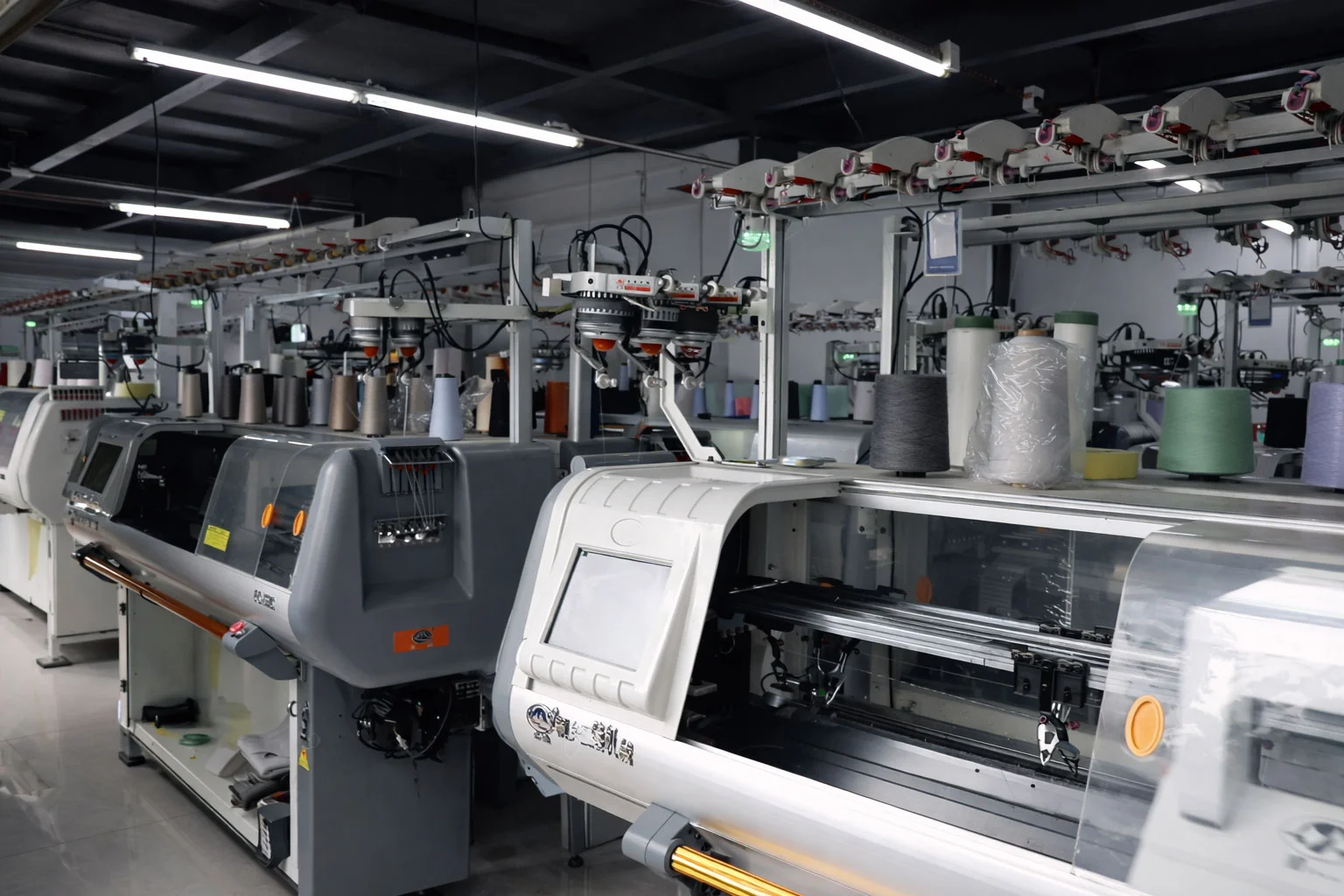
Jacquard and intarsia are both patterned knits — so what's the actual difference?
This is one of the questions I get asked most often. The five common knitwear technique terms — jacquard, intarsia, cable knit, crochet, and embroidery — sound alike, but they differ significantly in process, cost, and appearance.
This guide explains the five techniques from a production perspective so that next time you talk to a factory, you use the right terms and communicate clearly.
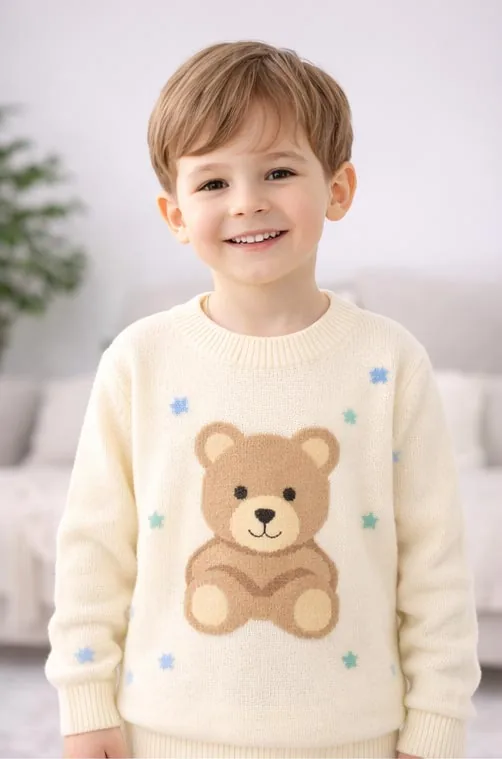
1. Jacquard — Integral Multi-Color Patterns
Jacquard is when the flat knitting machine knits two or more colors of yarn simultaneously to create patterns that are integral to the garment.
How it works: On a computerized flat knitting machine, yarns of different colors form floats on the reverse side (yarns that are not knitted float on the back), while the front side displays a clear pattern.
| Feature | Description |
|---|---|
| Face appearance | Clear patterns, neat edges — geometric, lettering, abstract patterns possible |
| Reverse appearance | Floats (yarns not knitted at color-change boundaries) |
| Thickness | Approximately 30-50% thicker than plain knit (due to reverse floats) |
| Stretch | Reduced in float areas; floats may rub against skin when worn next-to-skin |
| Best for | Geometric patterns, stripes, lettering logos, ethnic patterns |
| Relative cost | Medium |
When to choose jacquard: Your design features large, regular patterns (such as argyle, lettering combinations, stripe panels), and you do not mind reverse floats. Jacquard is efficient and suits medium-to-large runs of 200 pieces and above.
2. Intarsia — Color Block Panels, Same on Both Sides
Intarsia joins different colored yarns at the color-block boundaries, with no floats on either side.
How it works: Each color zone uses its own separate yarn. At the boundary between color blocks, the two yarns join like puzzle pieces. The machine automatically cuts unused yarns, leaving clean, smooth color transitions.
| Feature | Description |
|---|---|
| Face appearance | Clean large-color-block transitions, no float interference |
| Reverse appearance | No floats; face and reverse nearly identical (color-change yarn ends visible) |
| Thickness | Same as plain knit — no added thickness |
| Stretch | Full stretch retained — comfortable for next-to-skin wear |
| Best for | Large color blocks, geometric color panels, separated color logos |
| Relative cost | High (color-changing is time-consuming, more yarn waste) |
When to choose intarsia: Your design uses large color blocks (such as half white, half blue; a large chest color-block logo), and you need next-to-skin comfort without skin irritation. Intarsia delivers the most premium finish but is also one of the most expensive techniques.
Direct comparison: Jacquard vs Intarsia
| Dimension | Jacquard | Intarsia |
|---|---|---|
| Face | Clear multi-color patterns, neat edges | Large color blocks, clean transitions |
| Reverse | Floats present | No floats |
| Thickness | 30-50% thicker | No added thickness |
| Stretch | Reduced in float areas | Retains full stretch |
| Next-to-skin | Floats may irritate skin | Comfortable |
| Efficiency | High, suited to large runs | Low, color-changing takes time |
| Cost | Medium | High |
3. Cable Knit — Three-Dimensional Twisted Texture
Cable knit uses stitch manipulation — not color changes — to create three-dimensional twisted textures in the fabric.
How it works: Adjacent needle positions cross over each other, twisting the yarn like a rope to create a 3D texture. The simplest cable is 3×3 (3 stitches crossing with the adjacent 3), with more complex versions including 6×6 large cables, double cables, and wave cables.
| Feature | Description |
|---|---|
| Visual effect | Strong dimensionality, classic British/Scandinavian style |
| Reverse appearance | Reverse also textured (different from face) |
| Thickness | Cable areas are 20-40% thicker than plain knit |
| Stretch | Reduced in cable areas |
| Best for | Classic styles, menswear, Scandinavian designs |
| Relative cost | Low to medium (depending on cable complexity) |
When to choose cable knit: You want classic styles, menswear, or "textured but solid-color" sweaters. Cable knit is the most cost-effective way to add a "premium feel" to a garment.
4. Embroidery — Stitching Patterns Onto Finished Sweaters
Embroidery uses an embroidery machine to add patterns onto finished sweaters after knitting.
This is the fundamental difference from the other techniques: jacquard/intarsia/cable knit are completed during the knitting process, while embroidery is applied after the garment is fully knitted.
| Feature | Description |
|---|---|
| Flexibility | Very high — any pattern can be embroidered; adjustable later |
| Placement | Any position — chest, sleeves, collar, back |
| Reverse | Loose threads on reverse (trimmed or locked) |
| Disadvantages | Embroidered areas may cause the fabric to pucker; large-area embroidery can distort the sweater |
| Best for | Brand logos, small-area patterns, personalized customization |
| Relative cost | Low (small area) to medium (large area); plus embroidery digitizing fee |
When to choose embroidery: Your design is a brand logo or lettering, small in area (≤10cm), and fixed in position. Embroidery is the standard choice for brand customization — nearly every brand's first order includes embroidery.
5. Crochet — Hand or Semi-Hand Openwork Knitting
Crochet uses crochet techniques (rather than a flat knitting machine) to create openwork/lace effects.
| Feature | Description |
|---|---|
| Production method | Hand or semi-hand (fully hand-crocheted, or machine-knitted base + hand-crocheted flowers) |
| Visual effect | Openwork, lace, decorative edges, 3D flowers |
| Efficiency | Very low (hand work) |
| Cost | High (labor cost for handwork) |
| Best for | Womenswear lace trims, decorative edges, shawls, summer openwork tops |
When to choose crochet: Your design needs openwork lace, 3D flowers, or a handcrafted decorative finish. Crochet is usually applied as localized decoration rather than a whole-garment technique — a short crochet lace section at the neckline, cuffs, or hem is far more practical than an entirely crocheted garment.
6. Five Techniques at a Glance
| Technique | Principle | Cost | Appearance | Stretch | Best For |
|---|---|---|---|---|---|
| Jacquard | Multi-color flat knitting | Medium | Multi-color patterns, floats on reverse | Reduced | Geometric/ethnic/lettering |
| Intarsia | Color block joining | High | Large color blocks, no floats | Retained | Brand color-block designs |
| Cable | Stitch crossing | Low-Med | 3D twisted texture | Reduced | Classic/menswear/Scandinavian |
| Embroidery | Post-knit processing | Low-Med | Any pattern, backing threads | May pucker | Logos/lettering/small patterns |
| Crochet | Hand crochet | High | Openwork/lace/3D flowers | — | Localized decoration/casual wear |
7. How Brands Choose — 3 Decision Guidelines
- For logos / lettering → Embroidery ($2-8/piece, fastest and most flexible)
- For multi-color patterned sweaters → Jacquard if budget-conscious, intarsia for a premium finish
- For solid-color with texture → Cable knit (most cost-effective way to add premium feel)
- For openwork / handcrafted look → Crochet as a localized trim, not the entire garment
Do jacquard sweaters let wind through?
Yes. Because of the reverse floats, jacquard is approximately 20-30% less breathable than plain knit. For thick gauges (7G and above), this is generally not a concern. For fine-gauge jacquard, consider layering over a shirt or base layer in winter.
Do intarsia sweaters pill?
Intarsia itself does not increase pilling risk — pilling depends primarily on yarn material (short-fiber yarns pill more than long-fiber), not the technique. However, if the connecting yarn ends at intarsia color boundaries are not properly finished, they may loosen with wear and friction. Premium intarsia uses "hand-threading" to finish connections, adding ¥3-5/piece to the cost but producing a more durable garment.
Do cable knit sweaters stretch out over time?
Cable areas have higher knitting density and slightly lower elasticity, so they do not significantly deform with normal wear. However, if the cable is very large (6×6 or more) and the sweater is not given an appropriate relax/shrink treatment, "cable sag" may occur from hanging — the texture stretches under its own weight. Recommendation: cable knit sweaters should be laid flat to dry, not hung.
Choosing a technique is like choosing a yarn — there is no absolute right or wrong, only what fits your needs. The three most important steps: understand the effect you want → tell the factory your technical direction → confirm with a sample.
If in doubt, contact us and send your design — we will recommend the most suitable technique for your project. You can also learn about our production process and OEM/ODM customization services.