How many processes does a sweater go through from yarn to finished garment?
Most brands only see "factory takes order → ships." In reality, a standard crew neck sweater goes through 8–15 processes, each with dedicated machinery and skilled workers.
Understanding these processes will help you understand: why the lead time is what it is, why certain details cost extra, and why some factories can do certain things while others cannot.
The 8-Stage Production Flow: From Yarn to Finished Garment
| No. | Process | Position | Time Share | Description |
|---|---|---|---|---|
| 1 | Flat Knitting | Machine Operator | ~30% | Yarn is knitted into front, back, and sleeve panels on computerized flat knitting machines |
| 2 | Panel Inspection / Repair | Panel Inspector | ~5% | Check panels for dropped stitches, holes; manual repair |
| 3 | Linking (Looping) | Linker | ~25% | Assemble all panels into a garment (the step where it truly "takes shape") |
| 4 | Hand Sewing / Trimming | Trimmer | ~8% | Handle seam thread ends, reinforce collar and cuffs |
| 5 | Washing & Fulling | Washer | ~10% | Remove oils, soften hand feel, pre-shrink and set |
| 6 | Steam Ironing & Shaping | Ironer | ~8% | Steam iron to set shape, restore size and fit |
| 7 | QC / Needle Detection | Inspector | ~7% | Piece-by-piece appearance check + needle detection |
| 8 | Packaging & Shipment | Packer | ~7% | Hang tags, folding, bagging, carton packing |
Note: The above is the standard flow for a solid-color plain-knit crew neck sweater. For jacquard, intarsia, embroidery, beads, or other techniques, each added complexity adds 2–3 dedicated processes.
Part 2: Detailed Explanation of Each Process
Process 1: Flat Knitting
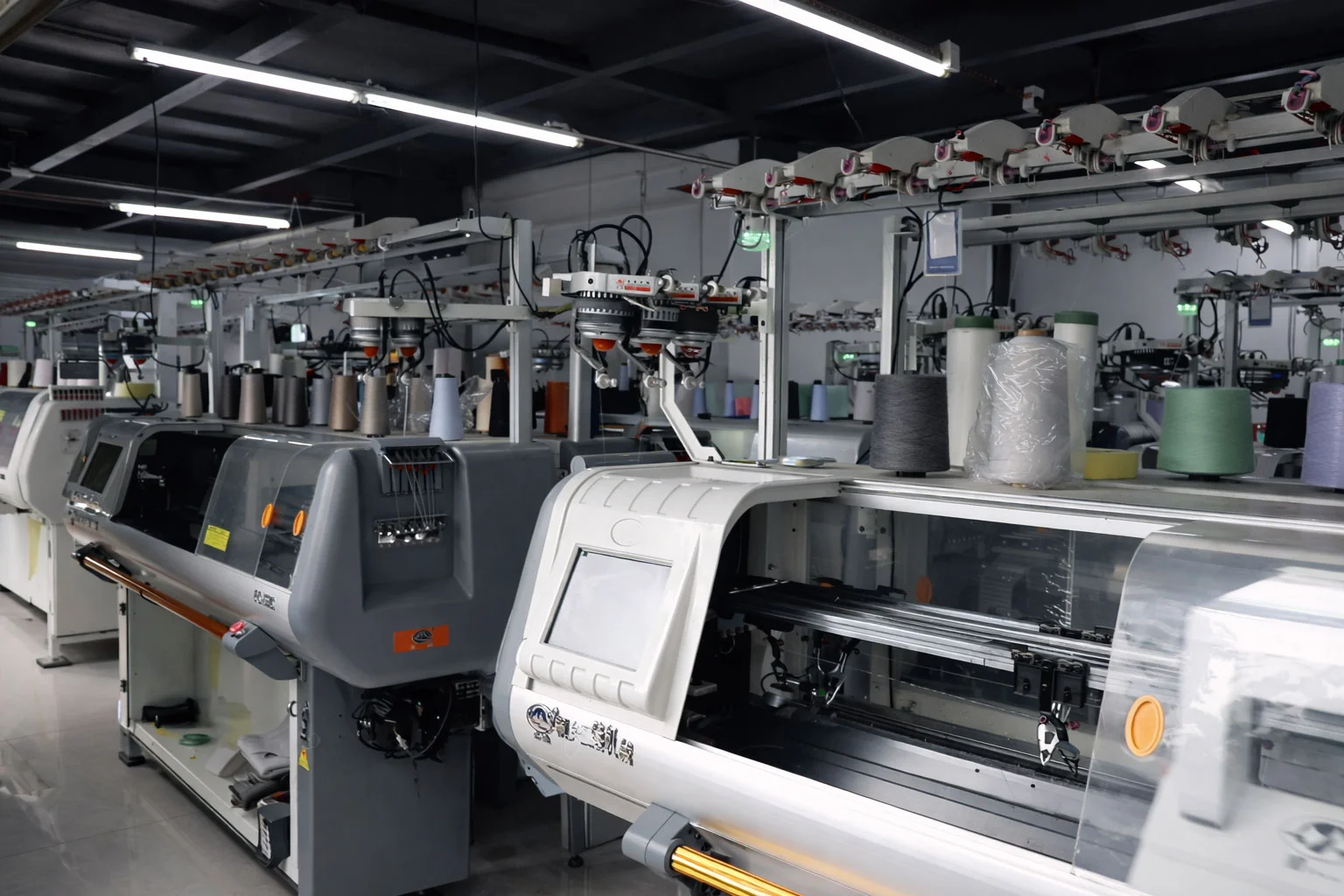
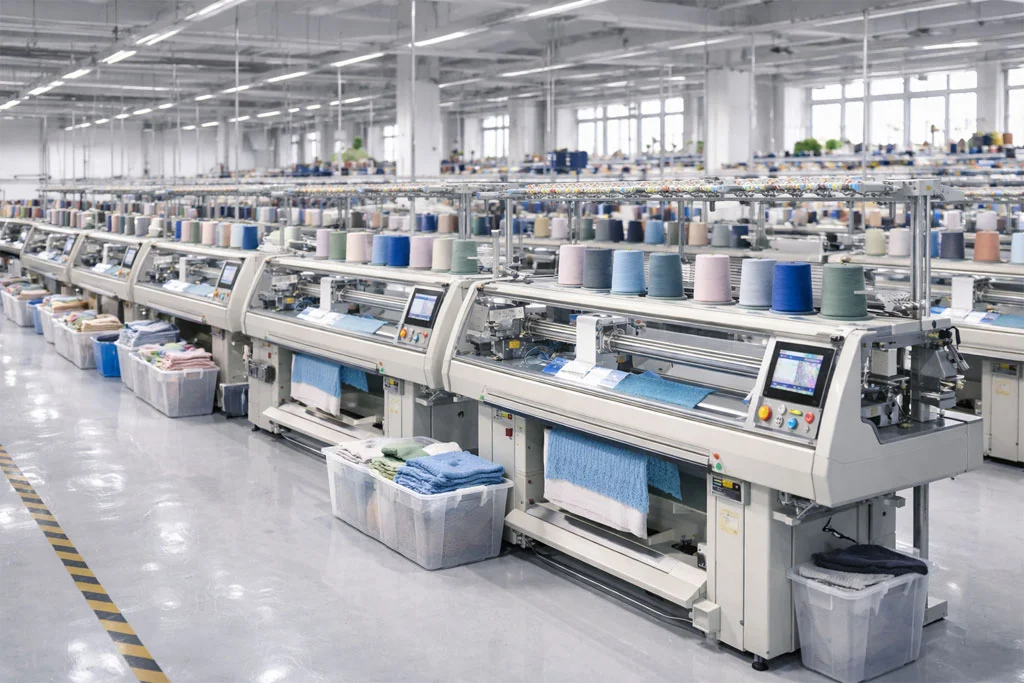
Flat knitting is the "printing press" of sweater production. Computerized flat knitting machines read the tech pack (pattern program) to control every needle's action. The most common computerized flat knitting machine brands are Shima Seiki (Japan) and Stoll (Germany).
This process determines:
- Whether the gauge (3G/5G/7G/12G/14G) specified in the tech pack is accurately executed
- Whether panel dimensions are within tolerance
- Whether jacquard, intarsia, and other patterns are knitted clearly
What brands should know: Flat knitting efficiency is approximately 30–150 minutes per piece (depending on complexity and gauge). A machine costing tens of thousands of CNY knits only 10–40 pieces per day. This is why a sweater takes 18–25 days from order to delivery, not 3–5 days.
Process 2: Panel Inspection / Repair
Once panels come off the machines, each one is inspected. Common defects: dropped stitches, holes, misaligned patterns. Unusable panels must be re-knitted.
Panel inspection may seem minor, but it is the clearest indicator of a factory's quality awareness. A professional factory has dedicated panel inspectors. Non-professional factories skip this step entirely, only discovering problems at the garment stage.
Process 3: Linking (Looping)
This is the most technically demanding and time-consuming process in sweater production.
The linker joins the front panel, back panel, sleeves, and collar stitch by stitch using a specialized looping machine. An adult sweater has approximately 800–1,200 joining points, each requiring precise matching.
Linking quality directly affects the sweater's lifespan: loose joins → underarm openings, shoulder seam splitting; uneven joins → distorted collar, asymmetrical cuffs.
What brands should know: The difference between a skilled linker and an average linker is visible at first glance on the finished garment — whether the shoulder seam is smooth and the collar is round. This is also why the linking workshop is always the department with the most job openings.
Process 4: Hand Sewing / Trimming
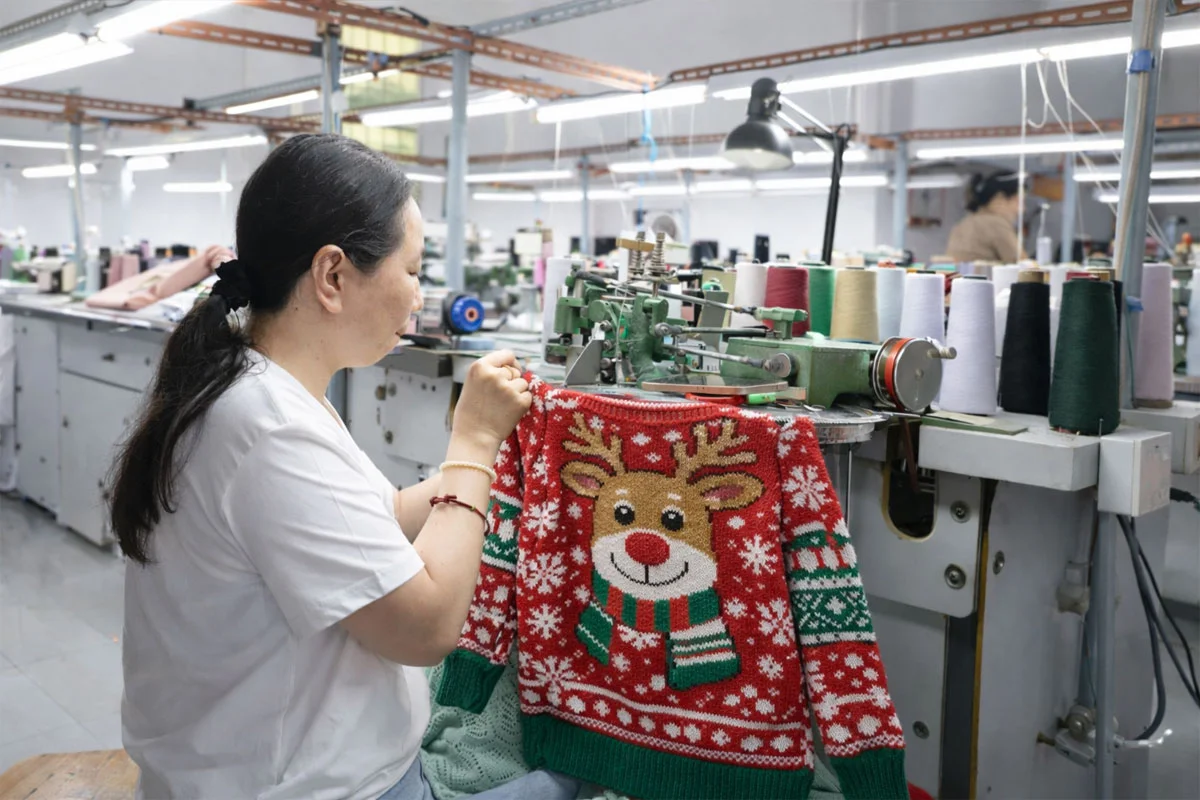
After linking, the garment still has thread ends and unevenness at the seams. The trimmer uses a crochet hook to hide thread ends into the knit structure, while reinforcing stress points like the collar and cuffs.
Signs of poor trimming: exposed thread ends, skin friction when worn, collar that stretches out over time.
Process 5: Washing & Fulling
This is the process that determines the sweater's "hand feel."
Washing has three functions:
- Cleaning — Remove oils and impurities picked up during knitting
- Fulling (felting) — Allow fibers to contract slightly in warm water, making the sweater denser and softer
- Setting — Release knitting stress to prevent distortion after washing
Washing parameters differ significantly by material:
- Cashmere/Merino: Gentle low-temperature wash with specialized detergent
- Wool: Temperature-controlled process with anti-shrink treatment
- Cotton/Acrylic: Standard wash
What brands should know: Sweater dimensions can change by 5–10% before and after washing. When approving the PP sample, brands must confirm the finished dimensions after washing, not the pre-wash dimensions.
Process 6: Steam Ironing & Shaping
After washing, the sweater is steam-ironed to restore standard measurements and create a crisp shape. Steam temperature and pressure are adjusted by material — cashmere and wool require different ironing parameters.
Process 7: QC / Needle Detection
Quality inspection generally includes:
- Appearance inspection: Check for color differences, stains, loose threads, pilling, knitting defects
- Size inspection: Sample a certain percentage of garments, measure chest, garment length, sleeve length to tolerance limits
- Needle detection: Pass garments through a needle detector to check for broken needles left in the garment (mandatory for export to European and American brands)
QC standards typically follow AQL (Acceptable Quality Level) 2.5, meaning 50 pieces from a 300-piece order are inspected, with ≤ 3 minor defects allowed.
Process 8: Packaging & Shipment
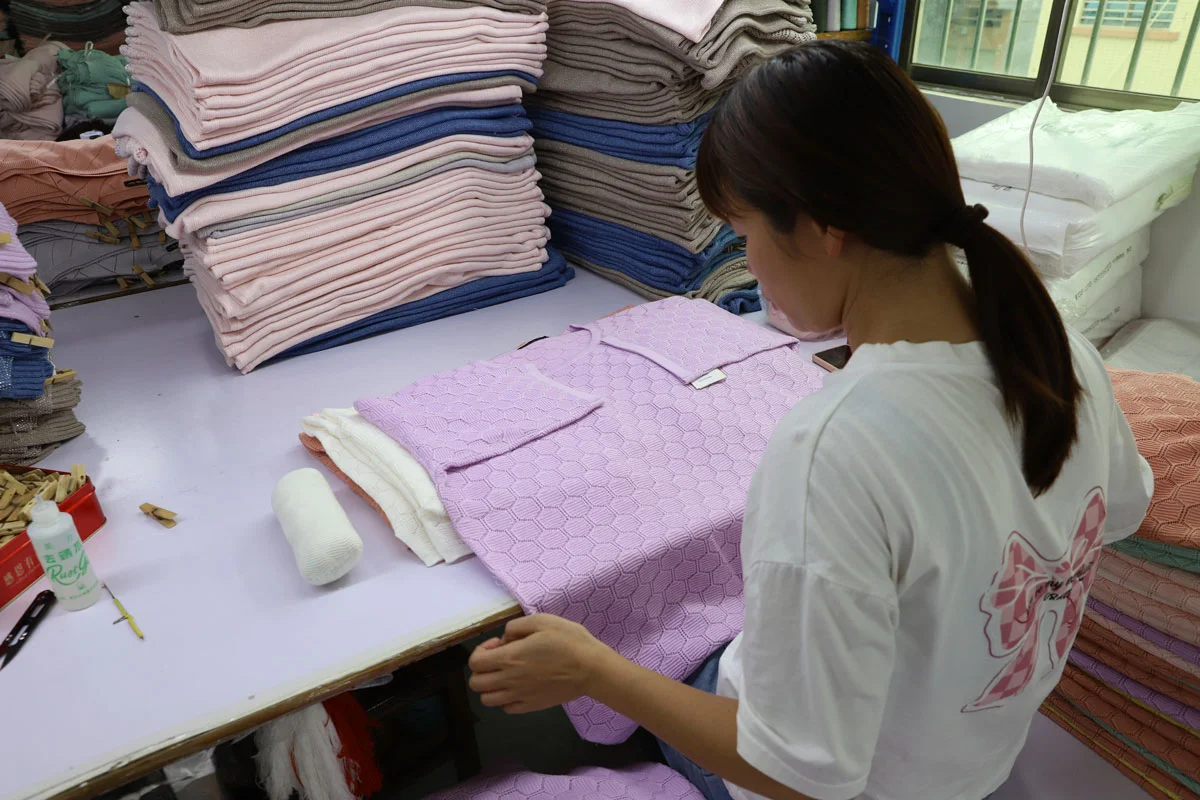
Finished sweaters go through: main label attachment, care label attachment, folding or hanging, dust bag, and carton packing. Bulk cartons also receive shipping marks for sea freight identification.
For export orders, packaging materials (plastic bags, cartons) may have environmental requirements (e.g., EU REACH regulations).
Part 3: Additional Processes for Complex Techniques
If a sweater involves any of the following techniques, each adds 1–3 specialized processes:
| Technique | Additional Processes | Total Processes |
|---|---|---|
| Jacquard | Double yarn change time, flat knitting time +40–80% | 8–10 processes |
| Intarsia | Longer knitting time, color changes require yarn cutting and hand-burying ends | 9–11 processes |
| Embroidery | Garment sent to embroidery workshop after construction | 9–10 processes |
| Beads/Rhinestones | Manual beading or heat-press application, purely manual | 10–12 processes |
| Fully Fashioned | No linking needed, but flat knitting time extends by 2–3x | 6–7 processes |
| Hand Crochet | Hand-crocheted, very low efficiency | 10–15 processes |
Part 4: Practical Value of Understanding the Processes for Brands
- Understand lead times: Knowing that linking and washing each take 25% and 10% of the time, you understand why "rushing" can only save a few days
- Understand costs: Linking (25% time share) is one of the highest labor cost processes — skilled linkers earn 30–50% more than average technicians
- Understand quality differences: The more complete the process sequence (no steps skipped), the more stable the quality — panel inspection + hand sewing + three QC checks offer 4 more safeguards than the simplified "knitting → linking → packaging" flow
- Understand quotation differences: Factory A's quotation is 15% cheaper than Factory B's — possibly because they "skipped" steps in panel inspection, trimming, and QC
Why does sweater production take 18–25 days?
Using a standard 300–500 piece order as an example: flat knitting takes about 5–8 days (depending on machine count and style complexity), linking 5–7 days (linkers are the most in-demand position in a factory), washing + ironing + QC 3–4 days, packaging 1–2 days. Add yarn ordering (3–7 days) and process transfer time, and 18–25 days is a healthy schedule. If a factory promises 10-day delivery, they are either skipping steps or pushing the order through at the expense of quality.
What is different about fully fashioned (seamless) sweaters?
Fully fashioned sweaters use specialized flat knitting machines to knit the entire garment in a three-dimensional shape in one go, eliminating the need for linking. Advantages: no seam thread ends, more comfortable for next-to-skin wear. Disadvantages: knitting speed is 2–3 times slower than standard machines, equipment costs are high, and not all styles are possible (complex cable stitches and jacquard are limited). Fully fashioned currently accounts for only a small market share (<5%), mainly concentrated in high-end underwear and athletic knitwear.
Understanding the sweater production process is the first step to "speaking the factory's language" when communicating. When you ask the factory "why does the lead time take this long," you can be specific and ask "are we waiting on flat knitting or linking scheduling" — and the factory will know you are a knowledgeable buyer.
For more production details, feel free to contact us or visit our production process overview page.